
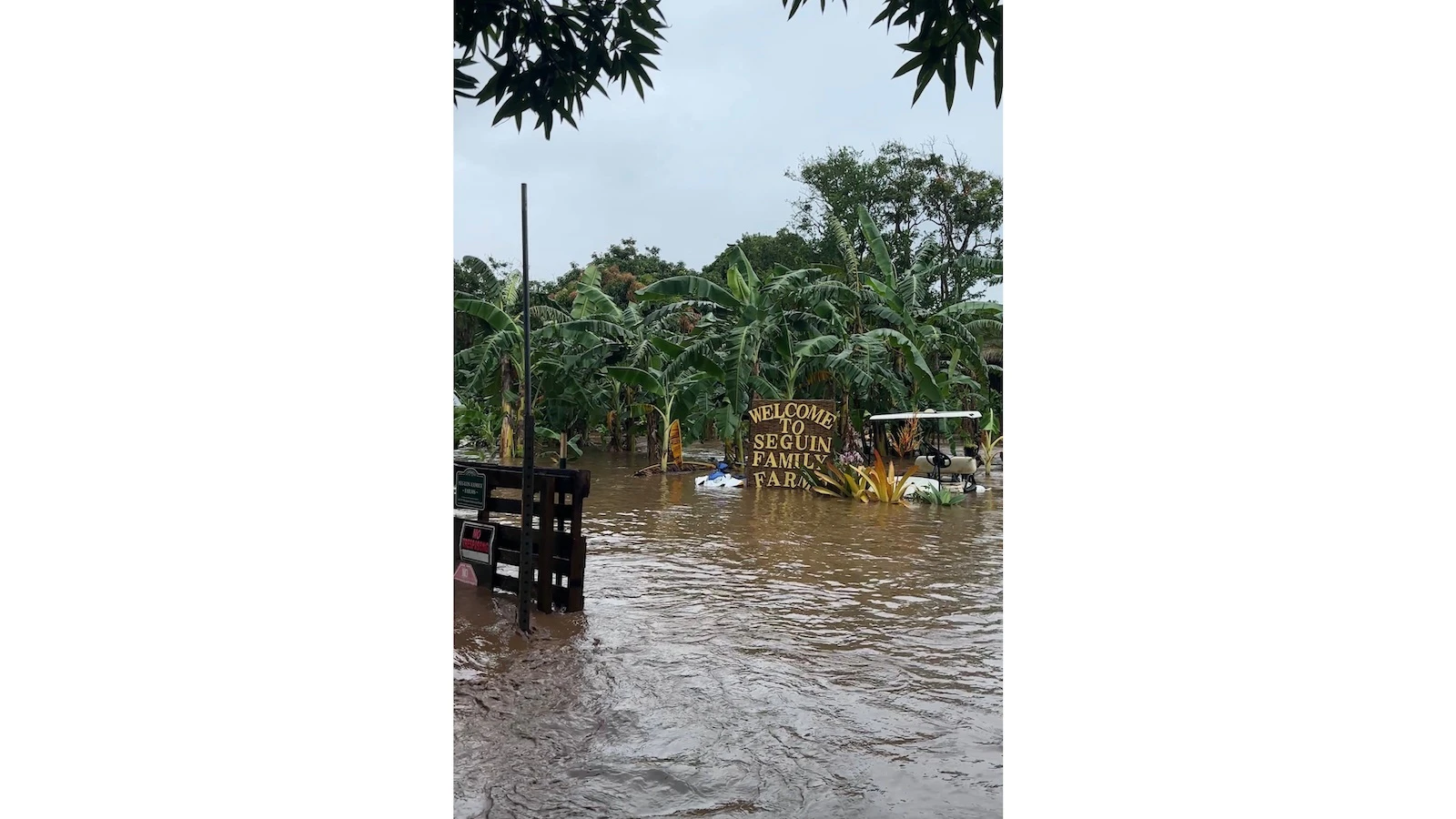
Around 3 p.m. on Sunday afternoon, Jordan Seguin — farmer and creator of Seguin Family Farms, which specializes in growing bananas and ti leaves — remembers that the sky was overcast, but it was no longer raining. His mom was tending to her garden; his dad went to feed the dog.
“As I was putting on my boots — I wanted to go look at the farm — I just heard a sound that was so unfamiliar,” Seguin says. “It sounded like things were getting pushed. I just saw three feet of fast-moving water coming toward the house. Luckily, it did not reach far toward the house, but it was nothing I’d ever seen before in my entire life while living and farming in Waiāhole.”
The flooding from Waikane Stream into Seguin Family Farms happened quickly, according to Seguin, who says this was the third time this year that the Waiāhole-based farm was flooded. He says that the farm is about two and a half acres.
“Everything just happened really fast and went away in less than an hour,” he says.
After the flooding, Seguin discovered the farm’s main water line was broken, and the farm currently has no running water.
“When I realized that (the farm has no water), it was devastating,” Seguin says. “There’s so much stream sediment, soft mud, rocks, small boulders that got pushed around and are scattered all over the farm. Newly planted banana trees are uprooted; vegetable crops — like eggplant and okra — are toppled over.
“If you look at the crops now, you’ll see some are still standing,” he adds. “I want to be optimistic and hope these are going to survive. If the ground continues to be this saturated — if we continue to experience rain as the days go by, for the remainder of this week — you’ll start to see everything start to die and turn yellow. At that point, nothing is savable; you just have to restart again.”
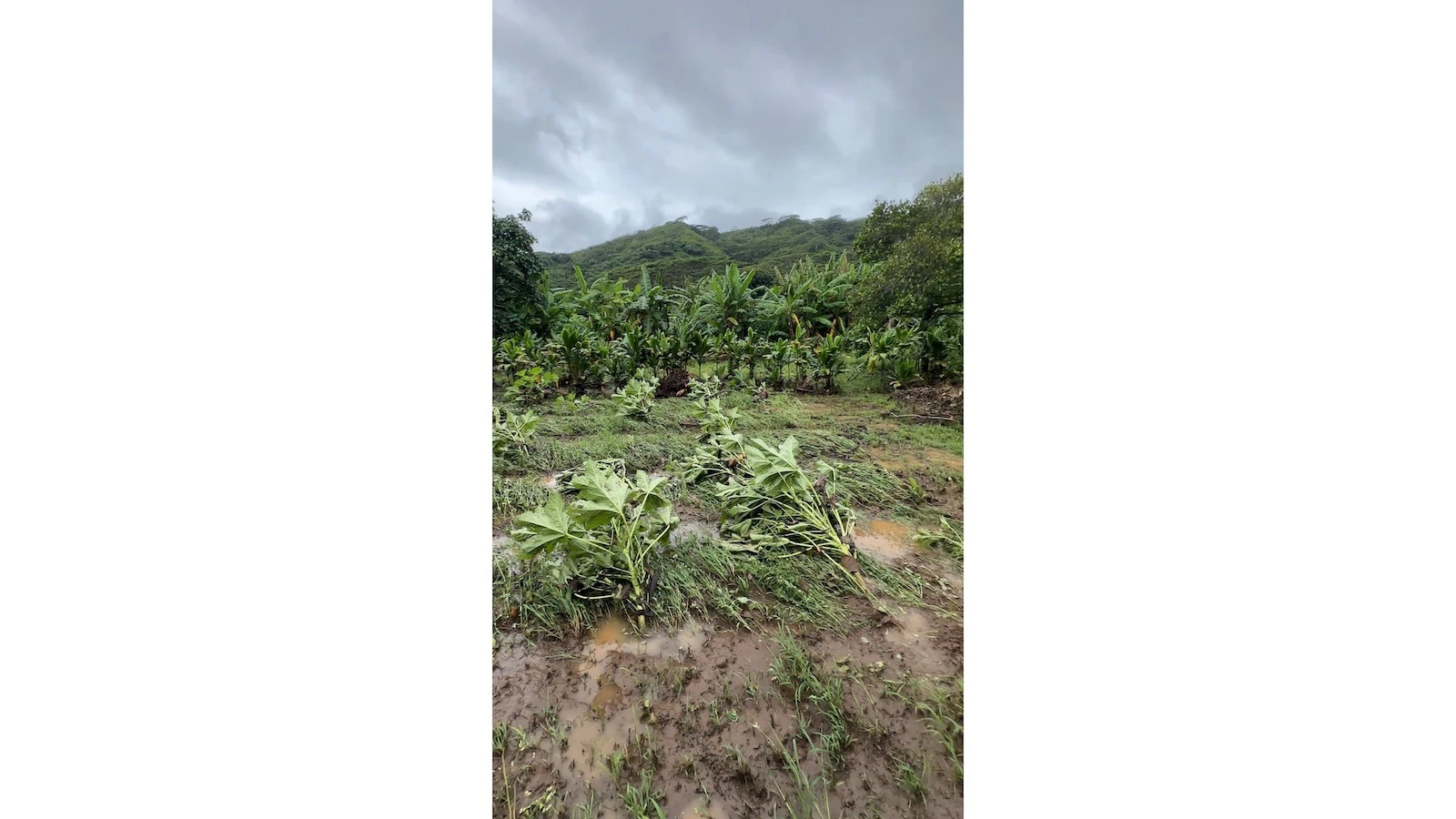
Prior to the flood, the farm had just replanted about 50 banana trees, along with other crops. Seguin says that the farm was harvesting bananas weekly and had a good rotation going.
“A week or two ago, we started planting our okra, eggplant, string beans and tomatoes,” he says. “Just before Lowell, we had pockets of really good weather; I’d say the farm really started to dry up. About two weeks ago, we started to replant the fields of empty bananas; after a banana tree produces fruit, you cut down the tree, harvest the bananas and that single tree’s cycle is over. With the nice weather we had, things were looking really good.”
While the family did see Lowell coming and made preparations — “After studying how the water and floodwaters flowed from the Kona Lows and Lala, we tried to dredge out and clear out natural waterways so we could prevent flooding,” Seguin explains — he says the rain “came out of nowhere” on Sunday, when Hurricane Lowell started its northward track.
“Lowell wasn’t even close to us on Sunday, but the rain and flooding of that size came out of nowhere,” he says.
“A lot of people say, ‘It’s not safe,’” he adds, referring to the video he took of the farm during the flooding. “At that point, it was waist high in certain spots, and it was hard to move. When it’s flooding like that, it was important for me to document it. I want to be able to study the natural flow of water; at that point, you’re fighting against nature.”
While the Waiāhole area is known for flooding, Seguin says flooding doesn’t usually happen every year. However, he says that things are different since it’s an El Nino year. (During El Nino, ocean temperatures are warmer, and there is a higher risk of tropical storms, according to NOAA).
“I have experienced flooding when I was much younger; I’ve watched how my uncle handed it and what happens to the farm during that time,” Seguin says. “I know a lot of people are concerned when flash flooding happens; it will stop a lot of traffic if Kamehameha Highway overflows.
“I understand the stream runs through different entities, so responsibility for it is complicated,” he adds. “But if we can get attention on this, there can be a way to mitigate this. Looking back on this, hopefully we can start to put more attention on taking care of our streams and our waterways.”
Currently, Seguin is looking around the farm, assessing damage and seeing what needs to be done next. A GoFundMe page has been set up to help support the farm; Seguin posted a video about fundraising efforts on the farm’s Instagram account.
“It was such a beautiful day on Friday; it was nice and sunny,” he says. “It hurts (to see what the farm looks like now), but I can’t stop what I’m doing. I want to be able to feed people, I want to grow food, I want to be able to support locally. That’s my main goal.”
Seguin says he will be posting announcements on social media, regarding volunteer efforts for those who want to physically help clean the farm.
“Originally, I was just thinking of fundraising $2,000 to help us; I didn’t expect to see how much it’s grown,” he says. “It’s so overwhelming, and we’re so thankful. This will help restore the farm to where it was before the Kona Lows, and make it even better so we can fully open our doors and have people come and buy locally. I know people want to do farm tours, but I can’t do that if the farm looks like how it is, and we’re not harvesting anything.”

Seguin explains that his family has been farming in Waiāhole since the 1970s, and he took the reigns on the farm about three years ago.
“We are part of Waiāhole Agricultural Park, which is a project owned by the state,” he says. “My family has been here since the ’70s; when the state acquired it in the ’90s, we’ve been leasing through them. It’s a lease that started with my grandmother, who passed away three years ago, and my uncle, who is still alive but had to officially retire from the farm. It’s my job to continue and preserve what my uncle and grandma started.”
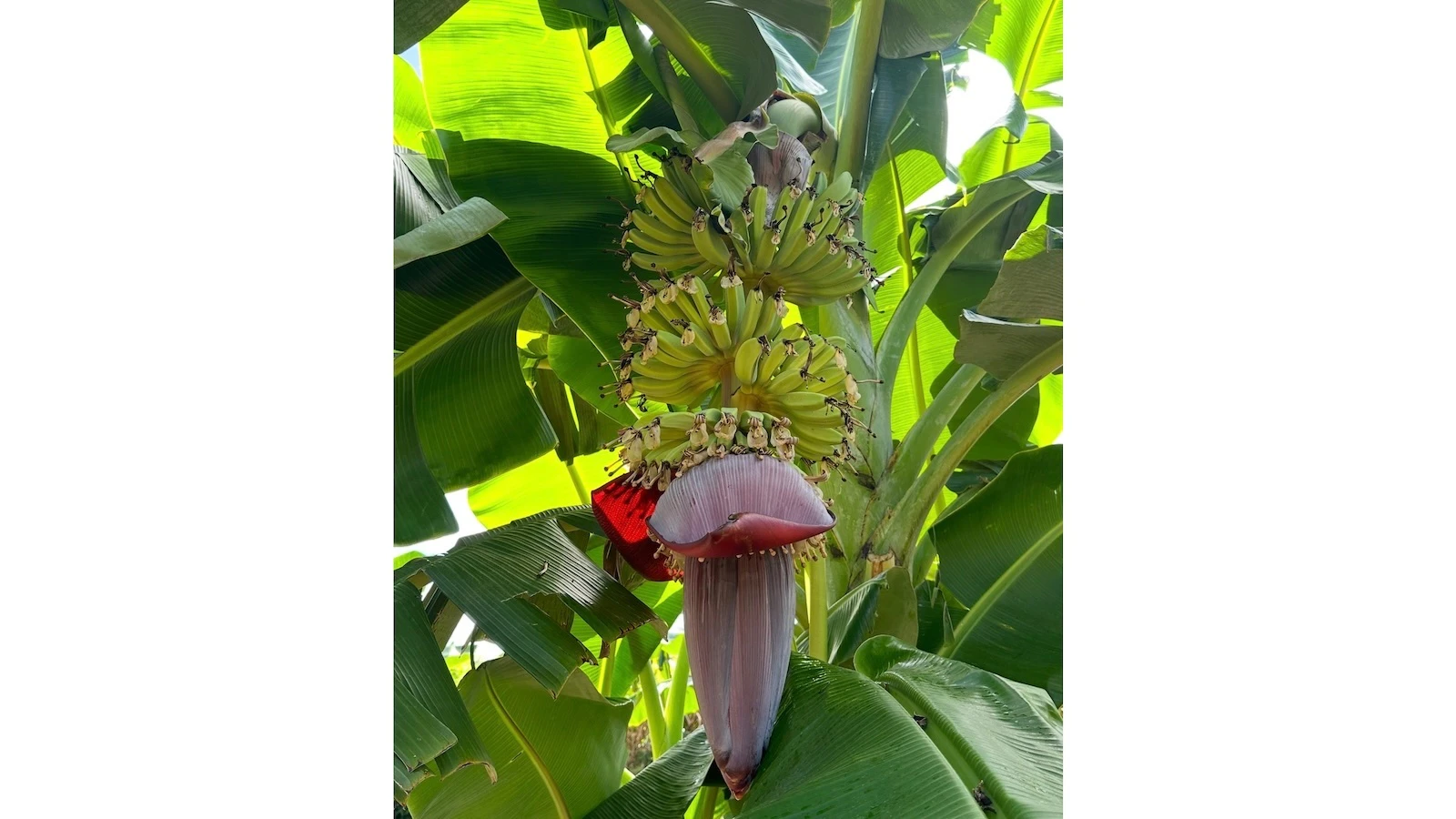
Seguin says the family farm — run by his parents, his two younger siblings and himself — grows Saba bananas, which is often used to make Filipino desserts like turon, a popular snack featuring thinly sliced bananas in a spring roll wrapper that’s fried and finished with caramelized brown sugar.
“Saba is a cooking banana variety found in Filipino cuisine,” Seguin says. “These are the bananas you want to use for banana lumpia. If you boil it when it’s green, or just before it turns ripe, it’s very similar to a potato. Just as we would use ‘ulu, or breadfruit, you can use the banana as a substitute for rice.”
Seguin explains the farm’s ti leaves are often used for lei-making. He says a lot of the farm’s crops, like okra and eggplant, are staples in Filipino cuisine.
“Our crops are things our grandparents in the Philippines would typically grow, but bananas are our main crop,” he says. “Being Gen Z, I wanted to share the farm experience online through social media.”
Seguin’s mission for the farm is not only to plant food to feed families, but also to celebrate Filipino heritage and culture in Hawaiʻi.
“It’s been a journey for me, too — to understand where you came from, and to understand the ‘aina that you stand on,” he says. "That’s our whole vision — to understand and perpetuate Hawaiian values, and to celebrate and honor Filipino heritage.”
Seguin says it took about three years to reach the goal of harvesting bananas weekly, which made the Kona Low storms in March especially devastating. He explains that, after planting banana trees, it takes six to eight months for the trees to mature. Once the trees start flowering, fruits will start to form.
“Because we had a lot, we were on a rotation where we could harvest the bananas weekly,” he says. “During the Kona Lows, the farm flooded — at that time, what I thought was tremendously — and the storm left behind so much saturated areas in the farm.
“Bananas love water, but if there’s too much water, it’ll lead to the spread of diseases, fungus and viruses within the root system, and it’ll start to create root rot,” Seguin adds. “It was devastating — 50% to 60% of the bananas that we had planted experienced that after the Kona Lows in March.”
After the Kona Low storms, Seguin applied for an agricultural grant to receive financial help from the state. In August, he was able to use the money to rent an excavator to dig out the rotten banana trees and clear out the fields to replant.
“We don’t have machine equipment here on the farm,” he says. “After the Kona Lows, small patches of the farm all needed attention. Here we were, a fully family-owned farm, trying to play catch up. And then Lala came.
“I’d say that, at the time of Hurricane Lala, though the flooding was devastating, we didn’t lose much because we’d already lost a lot from the Kona Low storms,” Seguin adds.
While Seguin states the “road to recovery” may take a while — “I’d say, give us a year and a half,” he says — he wants the community to know how grateful his family is for the support and encouragement they’ve received.
“We were overwhelmed by how much people wanted to donate; we really appreciate that,” Seguin says. “My vision is to open our doors more to the public — for people to come, buy locally, and enjoy the scenery here. After the Kona Lows, and now Hurricanes Lala and Lowell, it’s been so traumatic and mentally draining. But I want to continue the legacies left behind for us. For me, this is not to be rich. Just the fruits of our labor — feeding people — is very rewarding to me.”
Kelli Shiroma Braiotta can be reached at kelli@alohastatedaily.com.
For the latest news of Hawai‘i, sign up here for our free Daily Edition newsletter.


