

More than 50 years ago, the Kahoʻolawe Nine evaded a U.S. Coast Guard blockade and landed on Kahoʻolawe on Jan. 4, 1976. Those nine individuals, who protested the bombing of the island by the U.S. military, sparked the formation of the Protect Kahoʻolawe ʻOhana and the modern aloha ʻāina movement.
This year, PKO has been hosting a series of events, including the recent release of the album “50 Years of Aloha ʻĀina,” featuring mele about Kahoʻolawe, in honor of the anniversary and in recommitment to aloha ʻāina, or love and care of the land.
“We started the year off January 1,” said Kaipu Keala, who is a leader and cultural practitioner for PKO. “We had a proclamation press conference on Maui, and the Maui mayor came, and then from that moment we just declared that we're going to do this whole year of aloha ʻāina to commemorate the 50th anniversary of the renaissance of that term, of that model, of that philosophy, of that commitment to recognizing that the land is all we got.”
On Friday, Nov. 13, PKO and Bishop Museum will hold the 50 Years of Aloha ʻĀina Concert and Celebration: Laʻa, Maʻa, Paʻa!, which honors the release of the new album, “50 Years of Aloha ʻĀina” at the Great Lawn. That album — and corresponding concert — feature artists and musicians who created mele inspired by Kahoʻolawe, including Keahi Piʻiʻōhiʻa, Pōkiʻi Seto, Kiliona Young, Kaʻikena Scanlan, Kimié Miner, and Ikaakamai Nahuʻewai.
So far, the support and response to this call for aloha ʻāina has come from across the pae ʻāina and the world, Keala told Aloha State Daily.
As part of the events, a new treasure case installation about Kahoʻolawe called “Kanaloa ka Laʻa o Kohemālamalama: Unconquerable is the Divinity of Kohemālamalama,” is also on display on the third floor of Hawaiian Hall at Bishop Museum. It was co-curated by PKO and Pūlama Lima, a curator of archaeology, and will remain open until mid-April.
“Before the ʻOhana could even do any of the advocacy work that they did, the kūpuna who were part of the early founding had advised the key leaders that they needed to reconnect with the spiritual sense of Kahoʻolawe, which then needed a ceremony,” Lima told ASD in a Zoom call with Keala. “And so ceremony, as shared by folks like Auntie Davi, happened at every critical part of this movement.”
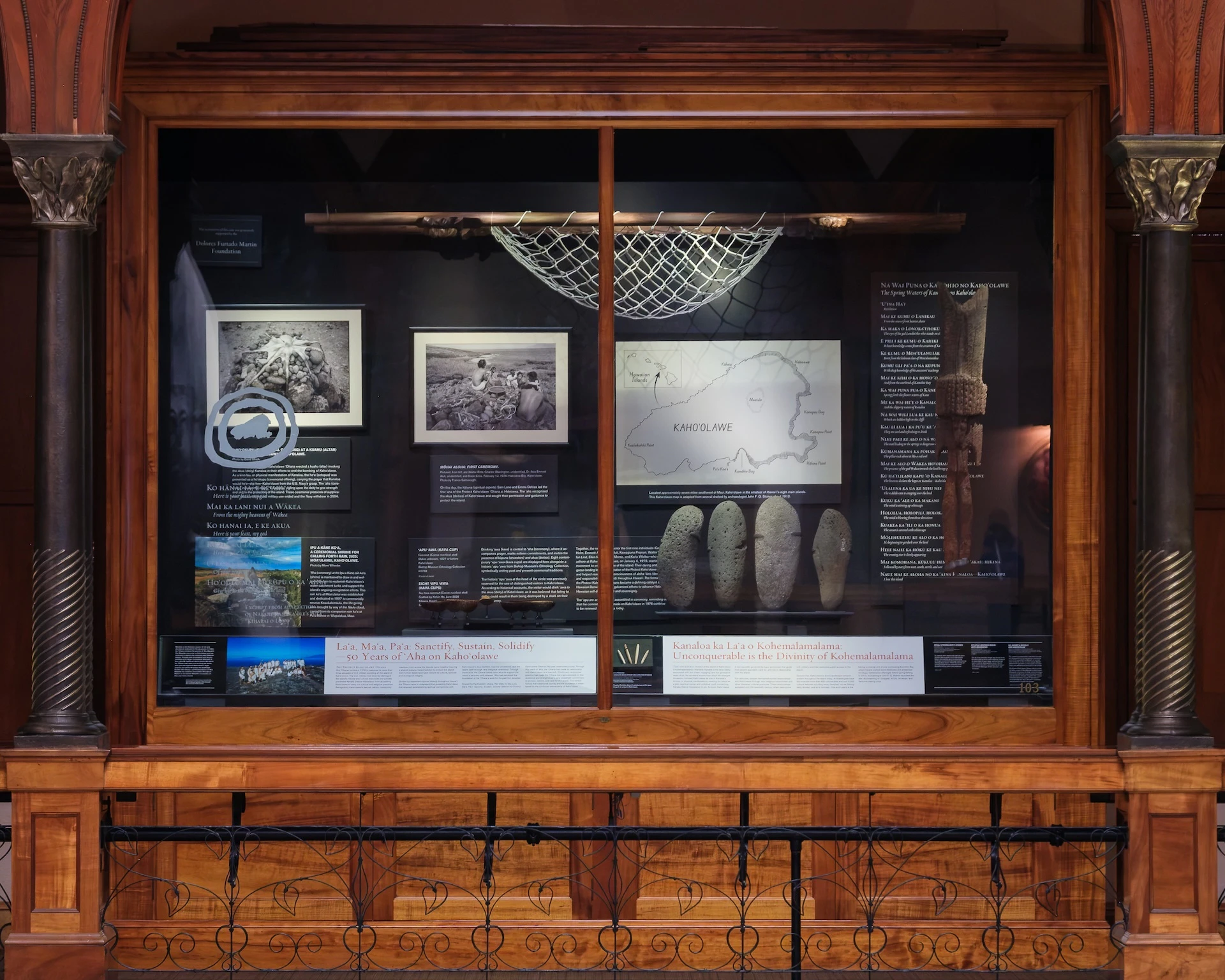
The installation shows the continuity of ceremony in this place, including contemporary works which reflect PKO’s participation, alongside historical objects collected from the same space by an archeologist in the early 1900s.
Kahoʻolawe is also known as Kanaloa and Kohemālamalama, Keala explained.
“Kanaloa is the god of the ocean, but the island is also known as a body form of Kanaloa, and it's one of the only islands in all the world that's named after a major god of a religion,” he added. “Because of that, it's always been a place where Hawaiians would do ceremony, where Hawaiians would train to reach the heights of their craft.”
It is especially an important place for navigators and a connection point to Kahiki, the land of the gods and where Hawaiians navigated from, he added.
The upcoming concert will also have a silent auction to generate funds to support PKO, and a booth where people can share their memories of Kahoʻolawe, including how the place has impacted them as individuals or families. There will also be ʻahahui o nā kauka, or Native Hawaiian physicians, there to administer health screenings.
“There is an importance in bringing people together after significant milestones, after significant ceremonies to partake in meal and to partake in fellowship,” Lima said.
In the early 80s, Harry Kunihi Mitchell, a founder of PKO, wrote “Mele O Kahoʻolawe” just after his son, Kimo Mitchel, had been lost at sea with George Helm.
“That song became an anthem that really carried the spirit of the movement and carried the spirit of aloha ʻāina and promised that if we do persevere, then we get chance as a people; we get chance for this Island,” Keala said. “And if we can save this Island, we can redeem the soul of the Hawaiian people.”
A similar sentiment was captured in the song, “Hawaiian Soul,” written by Dean John Osorio and Randy Borden after the search was called off for Helm and Mitchell, he added.
“This album is about redefining what that soul is for the Hawaiian people,” Keala said. “Finding new anthems to carry the next movement, the next 50 years of aloha ʻāina. Because we got to be able to rally together, and part of the way we rally is we sing. … We're just saying this land needs to be loved.”
Find the album, “50 Years of Aloha ʻĀina,” on streaming platforms, such as Spotify and Apple Music. Follow PKO on Instagram for updates.
Upcoming events
Paʻa: Kanaloa Kānaka i Kanaloa: Ea aʻe ka ʻOhana
6 to 8 p.m. on Thursday, Nov. 12
Hawaiian Hall; Bishop Museum.
Free. Details.
50 Years of Aloha ʻĀina Concert and Celebration: Laʻa, Maʻa, Paʻa!
5 to 9 p.m. on Friday, Nov. 13
Great Lawn; Bishop Museum.
Tickets are $10 for ʻōpio and kūpuna and $25 for adults. Proceeds from the concert go to PKO.
Katie Helland can be reached at katie@alohastatedaily.com.
For the latest news of Hawai‘i, sign up here for our free Daily Edition newsletter.


