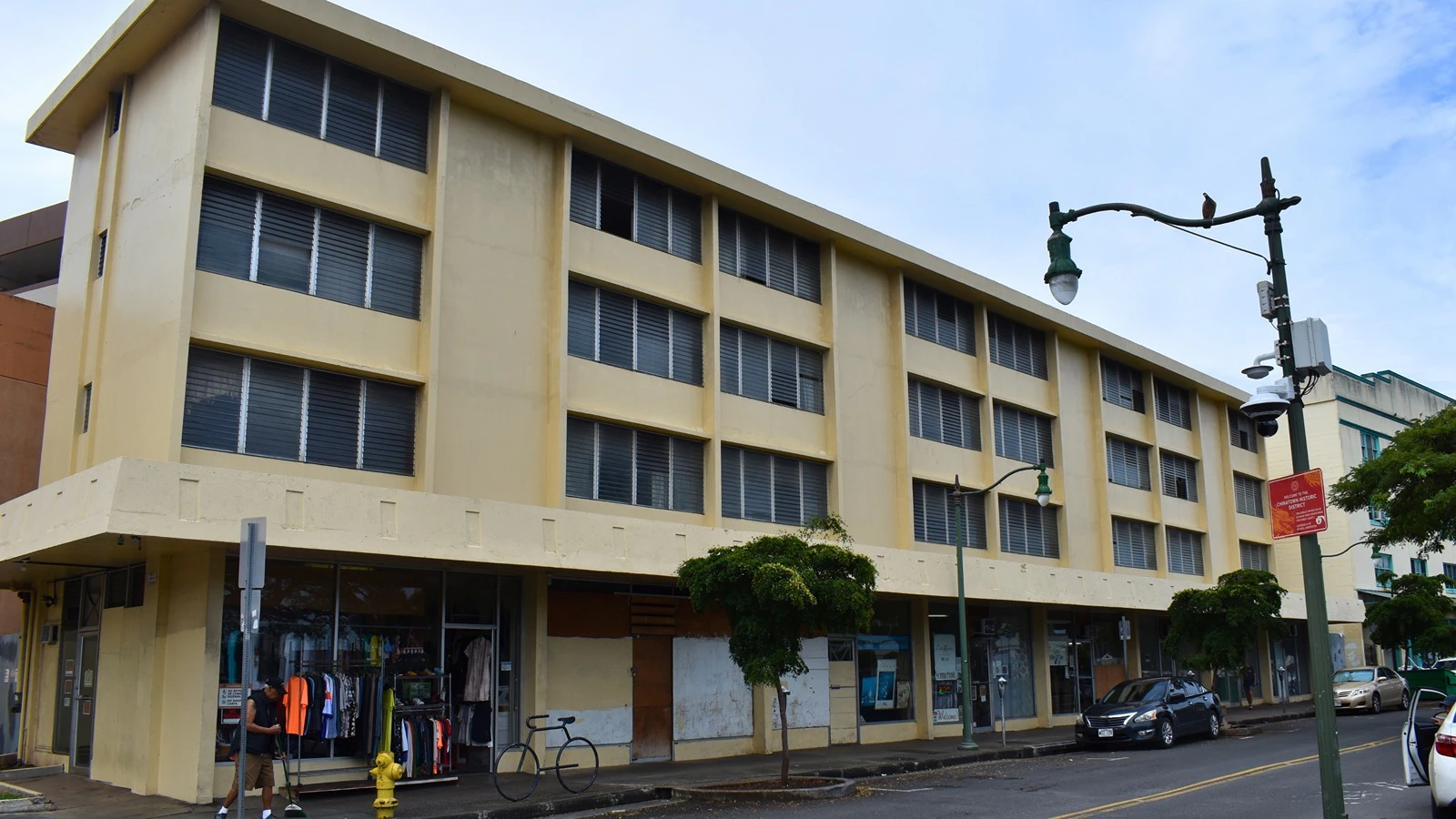
The City and County of Honolulu has acquired a Chinatown property in an effort to expand housing opportunities in Honolulu's urban core.
Located at 175 N. Pauahi St., on the corner of North Pauahi and River streets, the property measures 8,231 square feet. It was acquired for $4.52 million, an announcement Wednesday from the city's Department of Housing and Land Management notes.
Kevin Auger, director of the city's Department of Housing and Land Management, told Aloha State Daily in an emailed response to questions that the acquisition has been in progress for about seven months, after the seller's broker first reached out to the city in April 2025 to gauge interest in the property.
City representatives visited the site in May 2025, and a purchase and sale agreement was executed last November, he says. The sale closed on April 1.
Auger says the acquisition was funded by appropriations for affordable housing under the city's capital improvement program. Specifically, he notes, the funding comes from the Affordable Housing Mixed-Use Development program, which supports land acquisition, development and related infrastructure improvements to expand housing.
According to Auger, the city has determined that the project will proceed as a rehabilitation of the existing structure, managed by DHLM. The city is currently working to engage a construction team that will help determine the project schedule, scope and cost.
According to the city, the property is "currently significantly underutilized," with only four of 42 existing residential units occupied.
"Through this acquisition and planned redevelopment, the city plans to bring these units back into productive use, increasing housing availability in a high-demand area," the announcement notes. "In the near term, the city will focus on site stabilization and property management, followed by planning for renovation and construction. The goal is to return the existing units back to the market as quickly as possible while planning for additional affordable housing on the site."
Auger says that once the initial design development of the project is finished, the city will be in a better position to offer a construction timeline and target date for the units to return to the market.
Focusing on housing in Honolulu's urban core allows the city to "make the most efficient use of existing infrastructure, including transit, utilities, and public services," he told ASD.
And areas like Chinatown and Iwilei are centrally located, close to jobs and well-served by transit, which Auger says makes them ideal for expanding housing opportunities "where people can live, work and access services without long commutes."
The focus on housing in the urban core is by design.
"Our 2025–2028 Strategic Housing Plan prioritizes increasing housing production along the Skyline rail corridor," Auger says. "The Department of Planning and Permitting has been working on transit-oriented development (TOD) plans in neighborhoods around rail stations for 10-15 years. These are comprehensive plans that have undergone robust community engagement and have been approved by City Council. The administration is now activating these plans. These are the areas that makes the most sense for future housing development: infrastructure can be aligned to support development, they provide allow for the creation of walkable neighborhoods with convenient access to job centers, allowing households to be less reliant on automobiles and in return reducing greenhouse emissions.”
This is the latest move the city has made in an effort to address housing needs across the island.
Partnering with the development community to build housing on city-owned lands is another component of the three-year strategic housing plan the city unveiled last year. You can find the plan here.
Preferred negotiating partners have already been selected for the redevelopment of a number of city-owned properties, including 1615 Ala Wai Blvd. and 436 Ena Road in Waikīkī, 130 S. Beretania St. in Downtown Honolulu, Kapolei lots 2 to 5, and Iwilei Center.
Most recently, the city announced in March that it had selected a preferred development partner for the redevelopment of the former Dee Lite Bakery site in Kalihi.
Located across from the future Mokauea Skyline station, the city acquired the property at 1930 Dillingham Blvd. and 1907 Eluwene St. for about $8.4 million in 2019 "as part of a long-term effort to secure land for affordable housing near transit," the city said then.
Housing continues to be a major challenge in the Islands. Hawai‘i Housing Finance and Development Corp.'s 2024 Hawai‘i Housing Planning study, which was published last year, found that Hawai‘i needs an estimated 64,490 additional housing units by 2027 to meet demand.
Stephanie Salmons can be reached at stephanie@alohastatedaily.com.
For the latest news of Hawai‘i, sign up here for our free Daily Edition newsletter.