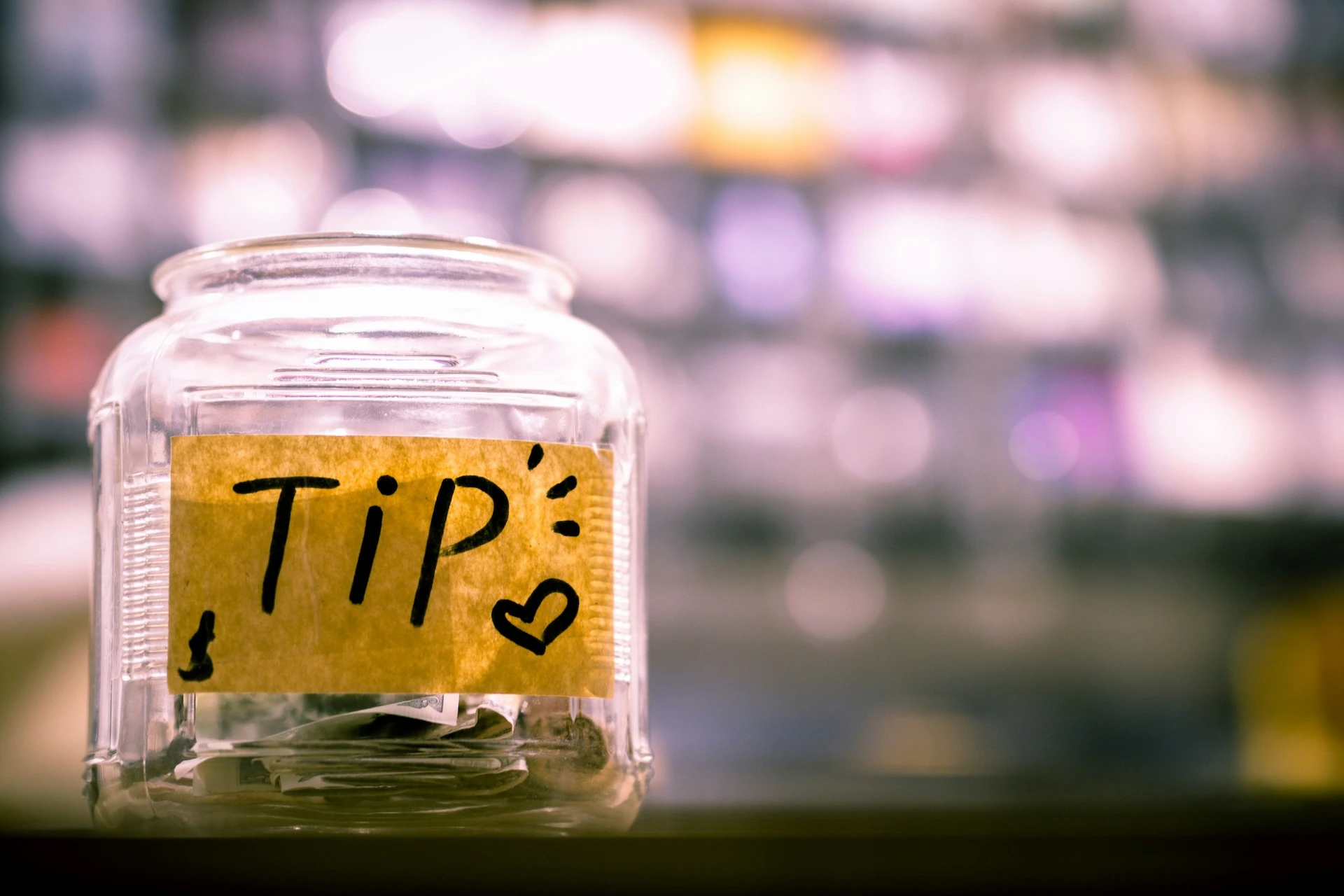
Tipping is not just a city in China.
Yes, most of us have heard this and other catch phrases when it comes to one of the most controversial issues that has the potential of impacting our overall economy and our society as a whole.
Tips.
Let's start with the origins and definitions.
I have always been of the mind that TIPS is the acronym for "To Insure Prompt Service."
However, The Columbus Dispatch seems to differ.
The formation of words from acronyms was very rare prior to the 20th century and typically involves technical terms. "Scuba and "radar" are examples from English, while "flak" is an example from German. The oft-repeated story of "tips" meaning "to insure prompt service" is in fact an urban legend.
The Oxford English Dictionary places the origin of "tip" as a slang word used by criminals more than 400 years ago, and the dictionary provides historical examples.
In the 18th century a tip was a gratuity given to a servant. The OED's earliest usage of tip involving waiters comes from 1825: "Sir Harry was liberal in his ‘tips’, and consequently a great favorite of Phillips (the waiter)." In this period, however, the word could also denote a bribe, as in this usage from 1819: "To take the tip is to receive a bribe in any shape."
Ok, that was our big brain moment of the day.
Consider this:
In the U.S., tipping is a standard, expected practice for services, typically ranging from 15% to 20%+ for restaurants and personal services, aimed at augmenting low base wages for workers. Average service usually merits 18-20%, with 15% for acceptable and 10% for poor service. Tipping is meant to reward good service, but in the U.S., it specifically exists to supplement the income of service workers who often make a "tipped minimum wage" as low as $2.13 per hour, allowing employers to pay less directly.
It appears we're going to have another big brain moment.
The first part of the aforementioned is pretty standard fare. We all have an idea of tipping protocol.
Those of us born and raised in America grew up with the notion that you go out, you are served and you leave a gratuity, a tip. My standard is 20% if all went well. I'll go higher to 30% if things went exceedingly well. Those things start with a genuine greeting and a smile. Don't know why but that most basic element of good service is often ignored.
Amongst others are accurate order taking, all parties served the same courses at the same time, expeditious but comfortable tempo throughout the meal and a respectful presentation of the bill with a genuine smile while closing out the check.
As with most experiences there are at least two sides to every story.
Clients and customers are not privy to the behind the scenes in a restaurant. There are many who don't believe that we should. Ok. But the title "server" does not mean "servant." I don't know what the percentage is of customers who are just jerks. You know what I'm talking about. Loud, curt, and borderline offensive these are the ones that will challenge the patience and professionalism of any team member. That kind of behavior from customers is simply not acceptable. You have an issue then talk it out with your server and, if need be, then chat with management. "Karens" should not be allowed.
Conversely, staff that are inattentive, showing attitude and simply are borderline rude are not acceptable either. It can be frustrating to a paying customer when confronted with lackadaisical performance and indifference.
Advice?
The word is empathy.
Servers, if someone is acting inappropriately, then it's your job to turn them around. That's done with kindness, humor. or just some space for a moment. The customer may have learned some bad news or had a tough trip to get to the restaurant on time. Perhaps it's just a bad day. We all have them. This is an opportunity to turn a lousy time into a very positive experience.
Customers, if your server is acting inappropriately, then it's your job offer some consideration. That is done with kindness, humor, or just some space for a moment. The team may be short staffed, and he/she is working a double with very little time off, there may be back of the room issues such as the kitchen not communicating about orders being filled or a myriad of other issues. Perhaps it's just a bad day. We all have them. This is an opportunity to turn a lousy time into a very positive experience.
Back to tipping.
The one red flag is the need of the customer to discretionarily fund the server's paycheck; not the employer.
But that's not necessarily true.
As of Jan. 1, the State of Hawaiʻi mandates that tipped employees receive $16 per hour. That means the employer not only is responsible for the staff's hourly wage but other regulatory requirements such as Social Security, workers comp and health insurance for those working 20 hours or more per week. Throw in hard costs such as lease payments, utilities, HR, advertising/marketing, insurances and more then you'll understand why a caesar salad with chicken breast can run up to $25.
There are a few other concerns regarding restaurant commerce.
A trend of questionable bill add-ons that come to the customer's surprise.
I experienced this recently in Seattle when after dining near Pike's Place, the check had a 3% "Takeout container fee." No takeouts for us but an added fee. Here at home a diner posted on social media about a local restaurant inserting a 3% "Kitchen appreciation fee." The reaction from TikTokers was profound. This may be technically outside the tipping ZIP code but it speaks to hijacking customers for more cash.
Customers are tiring of the nickel-and-diming. Just look at Vegas. Visitors were tired of exorbitant prices for bottled water, cups of coffee and the granddaddy of them all — resort fees. Consequently, tourism numbers and gaming revenues recorded losses for two consecutive years. Now you are seeing a return of price reductions, no resort fee, cheaper parking (when it was free forever) and "all-inclusive" packages in major properties. The key? Getting away from unfairly squeezing visitors and reinstating transparency and value.
We don't want island dining to go through similar tribulations.
At the end of the day, inspire servers and the back of the house to create an inviting environment and management to stop the surreptitious money grabs. Customers, I don't buy the line, "If you can't tip then don't eat out." Customers, if you're cool and the restaurant under promises and over delivers then one thing is for certain.
Tipping is NOT just a city in China.
Tipping will be done gladly when the environment and the experience are positively memorable.
Rick Hamada is a columnist for Aloha State Daily; the views expressed are his own.