For nearly two decades, Kumu Earl Kawaʻa, 81, has offered Board and Stone, cultural workshops for ʻohana across sites on Oʻahu, where he currently resides, and most recently on Molokaʻi, where he was born and raised.
Growing up in Hālawa Valley, the Molokaʻi High School graduate said, “Cultural ʻike and connection to the land and ocean has served me well. Otherwise, I wouldn’t have had the depth, which is something I realized later in life.”
“I left Molokaʻi [when] I needed to. I didn’t want to be the best pineapple picker, but I was headed that way,” Kawaʻa said with a laugh, noting that soon after he served in the Molokaʻi National Guard and in the Peace Corps. He received a bachelor’s in psychology and master’s in social work by 1982 and followed his passion working with nonprofits and schools, serving as a cultural specialist for Kamehameha Schools for 18 years. Later, he went on to help address public housing, homelessness and economic development, particularly advocating for Native Hawaiians.
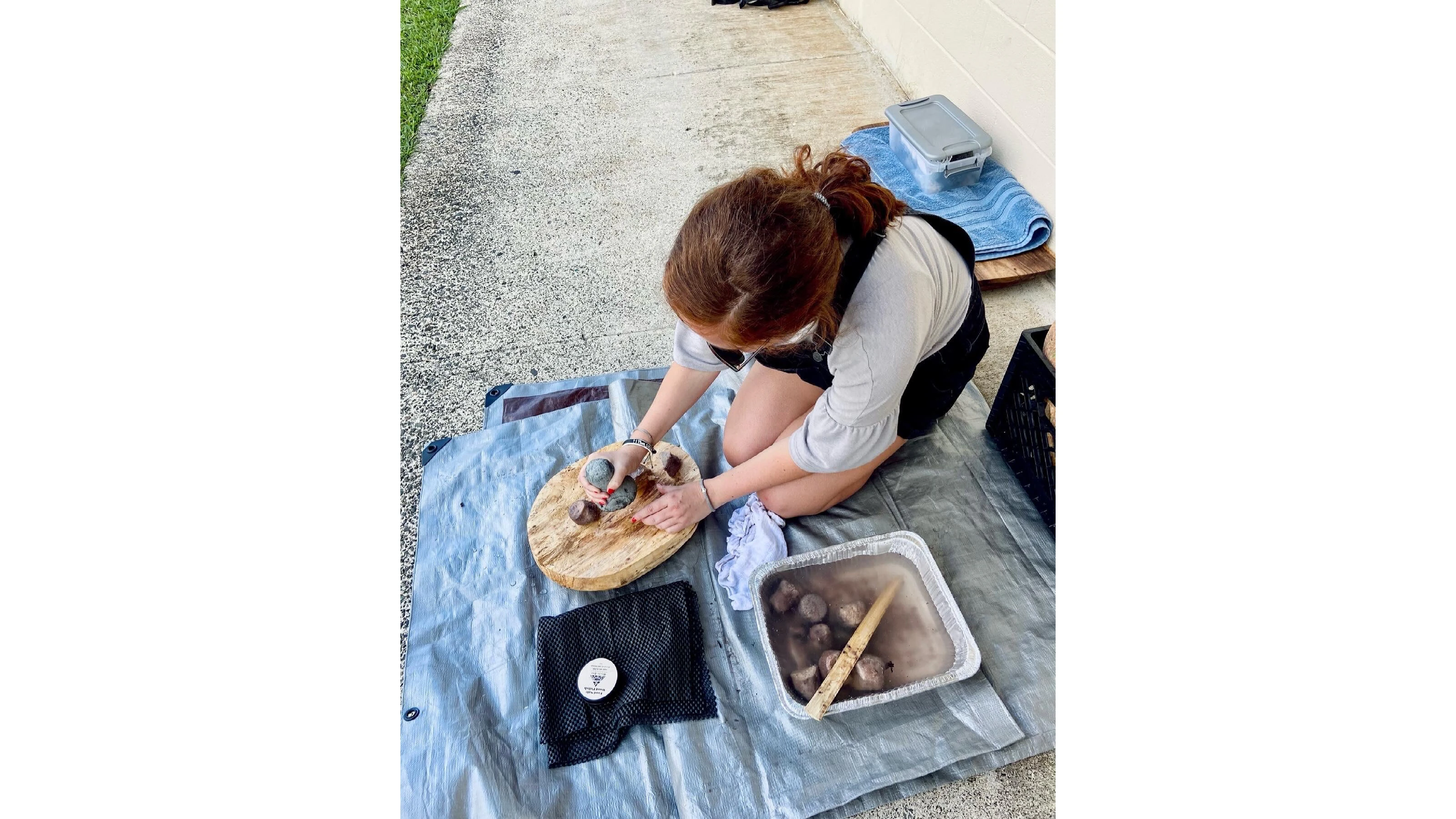
In 2010, the cultural practitioner started teaching Board and Stone out of a garage. It took a couple years to formalize the program, which teaches families how to carve a wooden board (papa kuʻi ʻai) and shape a stone poi pounder (pōhaku) using only hand tools. Its mission — his “lifeʻs work” — is to put at least "one board and one stone in every home,” Kawaʻa told Aloha State Daily.
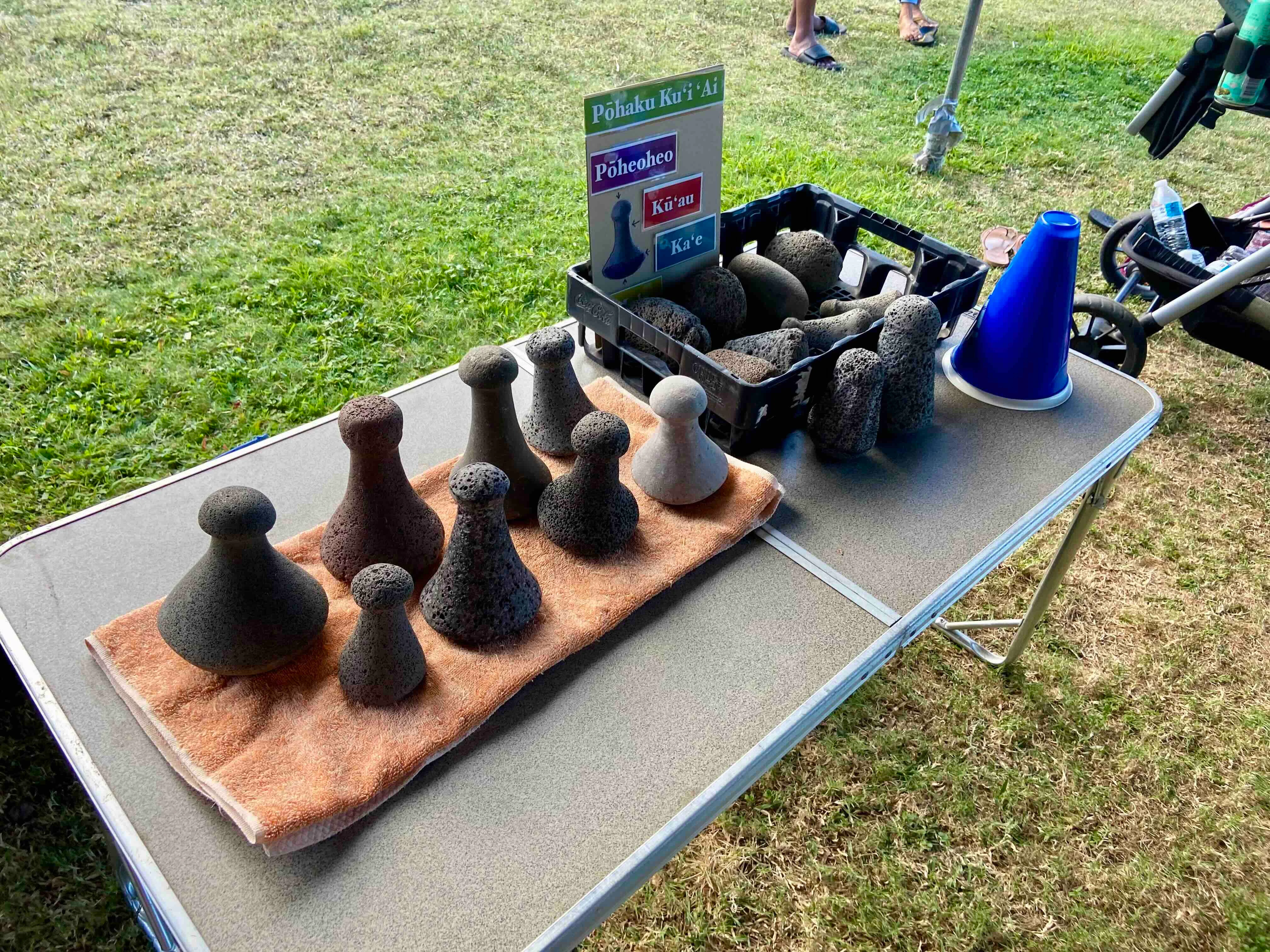
Across the Islands, Board and Stone gatherings take place weekly over about four months. Classes are primarily for instruction, including some outings on weekends, while most of the work on the boards and stones is done at home, according to an alakaʻi (leader).
“Board and Stone is a class I offer to people, but people have to make the choice to do it,” Kawaʻa said. “The orientation is designed to give them enough information. But they have no idea what they are in for — and thatʻs when the learning takes place.”
Alakaʻi Eric Keawe told ASD that during his own upbringing, his parents taught Hawaiian music more than culture, language and religion. “I’ve been here at Board and Stone for at least 10 years, so have some of the other alakaʻi, who are all like family. Because of his ʻike (Kawaʻa’s knowledge), I have gained knowledge and skills, even in public speaking, that I didn’t have before. I’m always learning and relearning.”
Beneath the surface, the classes perpetuate Hawaiian language, culture and traditions — showcasing Kawaʻa’s other skills in hale and rock wall construction, canoe building, farming, fishing, which he learned from his parents and community. His latest venture is learning the healing practice of hoʻoponopono, which his parents, Walter and Georgina Kawaʻa, were known for.
Earl Kawaʻa added: “But I am the only one left in my family, my two sisters died and my brother. My wife [Patricia] has always been my rock.”
The pair have a daughter, Yahna.
Looking back, “the ’60s and ’70s were the best time of my life, and what that means is that the knowledge and skills that I had, even teaching, was being refined. Of course, that was about when I met my wife.”
Today, Kawa‘a continues to be recognized for his “life’s work,” which has reached thousands of people through various speaking engagements and teaching opportunities.
“I love telling stories; but I am also learning to not talk so much.”
Recent recognition
Last month, the Hawaiʻi House of Representatives honored Kawaʻa during the 2026 legislative session “for dedicating his life to preserving Hawaiian language and culture, mentoring future generations, and strengthening communities throughout Hawaiʻi.”
This was not something he was expecting.
Rep. Lisa Marten of District 51, which includes Waimānalo, Keolu Hills, Lanikai and a portion of Kailua, experienced Kawaʻa’s expertise in traditional hale building firsthand, which she shared briefly with lawmakers on April 2. Watch the full presentation (HR210), here.
Kawaʻa asked four individuals to join him on the House floor that day, dressed in lei, to be recognized: Board and Stone Alakaʻi Kekipi Imamoto, a retired combat soldier who lives in Papakōlea with his ʻohana; Board and Stone Alakaʻi Kahiau Paik, a 2025 KS graduate who works with Hoʻokuaʻāina; Keoni Peters, a hale builder who worked on Marten’s project in Hāmākua; and longtime partner, Jenna Umiamaka, Human Resources director at Keiki O Ka ʻĀina (KOKA).

What’s next for Board and Stone?
Expansion, both nationwide and globally, Kawaʻa said, noting that it’s his dream to bring the classes to Japan, though, it will take sponsorship to help make this a reality.
And eventually, who will take over? “There are several people in place who will rise to the job. The opportunity is in their hands,” he added. “The foundation is already solid.”
“‘E ola mau ka hana a me ka ʻike o nā kūpuna.’ The work and the knowledge of our ancestors must live on.”
My Board and Stone moʻolelo
In transparency, I graduated from Board and Stone in spring 2021, invited by a former co-worker and alakaʻi, Roger Vistart.
I started at KOKA but finished with the Papakōlea class, due to restrictions to gathering sizes during the Covid-19 pandemic. What would have been a four-month class was extended to nearly one and a half years. But in that season, I never felt forgotten.
Kawaʻa was and is my kumu, and Keawe and Imamoto are my alakaʻis, among others. What I took away from their guidance, patience, selfless service and humility both in class and beyond was newfound confidence as a Hawaiian and a contributing member of this community.
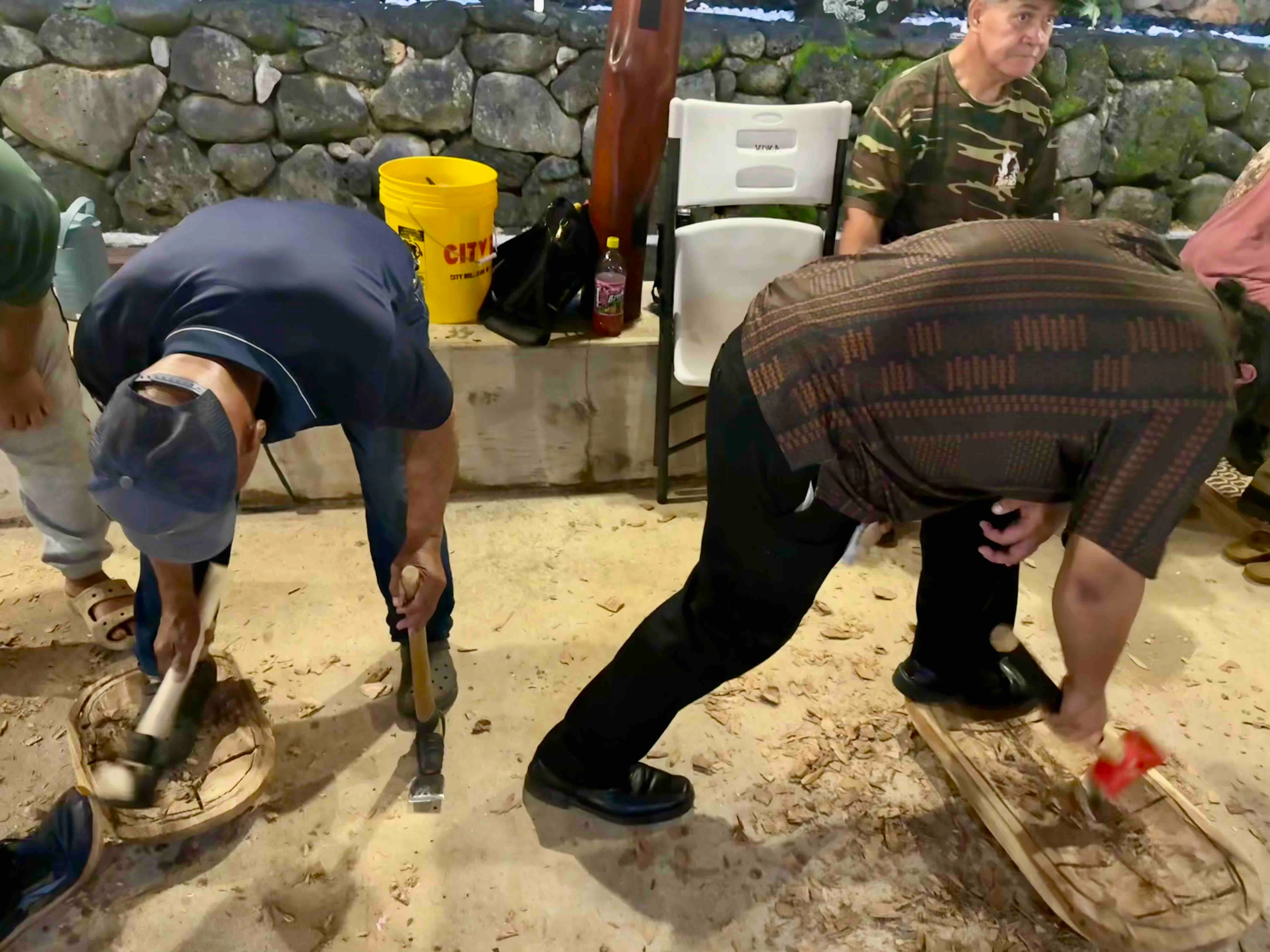
In April, I visited KOKA’s Board and Stone class, greeted by the sound of metal hitting wood, warm embraces and the aroma of blooming puakenikeni. It was good to be home.
A circle of alakaʻi had formed around Kawaʻa, who was hunched over a wooden board, sharing the technique of shaving down its rough corners using a koʻi (ax-like tool with metal blade). He invited some of them to try and gently corrected, as needed. The shavings should “curl,” he explained, while tapping lightly on their backs to help them keep rhythm.
Meanwhile, ʻohana were arriving with their own papa and pōhaku; parents set up their work stations and greeted one another, while keiki played together throughout the evening.
At the call of "Hūi!" kane and wahine lined up for Hawaiian protocol (loina or ha‘akoa) and prayer (pule). Next came instruction from alakaʻi about inoa (name) and moʻolelo (story), in which ʻohana will call their boards and stones and share their journeys, respectively, at an upcoming celebration, or hōʻike (to demonstrate one’s knowledge).
The hana (work) began and Kawaʻa, along with the alakaʻi, dispersed to assist families. Class concluded with moʻolelo presented by keiki in both ʻōlelo Hawaiʻi and English.
Afterwards, the alakaʻi-led debrief meeting allowed for reflection on their own personal growth, in addition to observations from those whom they worked with. The overall sentiment was gratitude for kumu’s “master class” in working the board and celebrating “how far the families have come along.”
In time, Board and Stone has taught me the importance of ʻohana, finding beauty in imperfection and finishing what you start through hard work, self-discipline and perseverance. I also learned how to pule and respect the ʻāina, honoring Ke Akua, those who came before me and those journeying alongside. Everyone has a moʻolelo that can be used to uplift and bring value to one another’s lives.
Those interested in learning more about Board and Stone can visit koka.org.
Kelsey Kukaua Medeiros can be reached at kelsey@alohastatedaily.com.
For the latest news of Hawai‘i, sign up here for our free Daily Edition newsletter.