
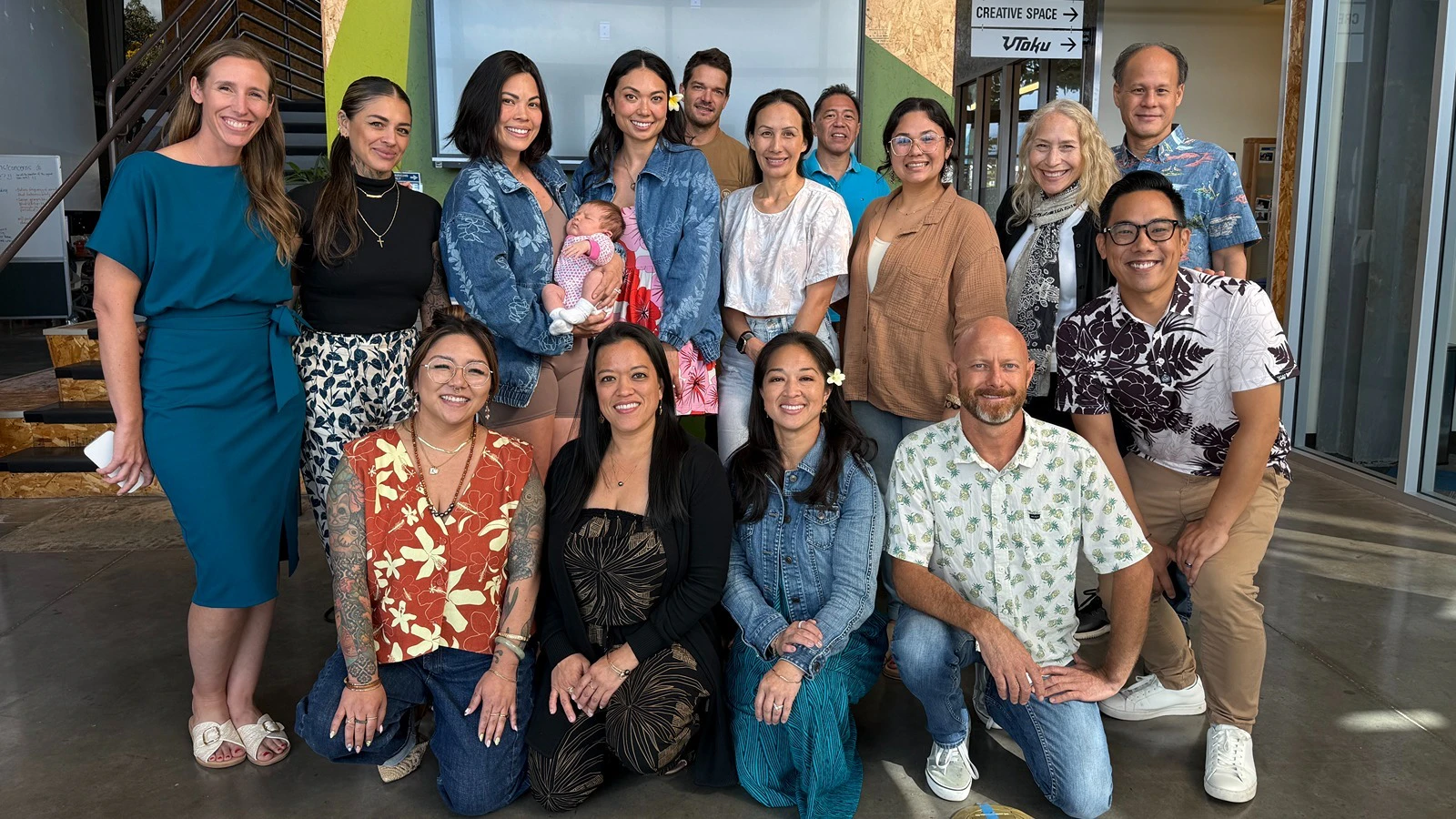
Mana Up has welcomed a new batch of entrepreneurs from across the Islands to its newest cohort.
Eleven companies were chosen from a record 256 applicants this year:
- Ahualoa Family Farms LLC from Honokaʻa on Hawaiʻi Island, which produces gourmet products from 100% Hawaiʻi-grown macadamia nuts, sourced from local farmers and roasted in small batches at their farm, Nuthouse Kitchen & Shop, and a restored historic factory.
- BUJO BAE from ʻAiea, founded and designed by Hilo-raised artist Jenna Aina Ikeda, creates bullet-journal-inspired planners, guided journals, notepads and hand-drawn stationery.
- Good Mana from Oʻahu (and Hilo on Hawai‘i Island), a farm-to-table wellness company that transforms Hawaiʻi-grown botanicals into supplements.
- Island Essence (Maui Kensington LLC) from Kahului, Maui, one of the longest-running locally made beauty brands in the state. According to Mana Up, Island Essence was founded in 1990 and has been handcrafting bath, spa and body botanicals for over 35 years.
- Maebo Noodle Factory Inc. from Hilo, a four-generation institution with 76 years of history, known for its One-Ton Chips and fresh saimin and chow fun noodles.
- Oceans End from Kailua, which designs handbags, lei-adornment keychains, and island-inspired accessories.
- Oysters Hawaiʻi from Honolulu, the state's first and only mobile oyster shucking and caviar catering company, which Mana Up says brings "luxury seafood experiences to weddings, corporate events and private celebrations across Hawaiʻi, Las Vegas, and California." Their signature smoked ponzu sauce is also available for retail.
- Vaui Social Liquids from Haʻikū, Maui, is a kava-based, alcohol-free beverage line born from Pauwela Beverage Co. — the Valley Isle's craft fermentation brewery.
- Wailua Granola Co. from Kauaʻi, crafts small-batch, dairy-free granola using fresh Kauaʻi coconut and raw Kauaʻi honey.
- Waimea Herb Com, from Waimea on Hawaiʻi Island, is a Native Hawaiian, family-owned tea company that works closely with regenerative farmers to craft herbal and black tea blends from locally grown botanicals.
- Yick Lung – Hawaiʻi’s Choice from Honolulu, a heritage snack brand being rebuilt for the next generation has roots going back more than 100 years, Mana Up says. The makers of "nostalgic local favorites" like Nibb-its and Li Hing Plum and Mango tablets are expanding distribution, modernizing packaging, and growing e-commerce.
Mana Up is a business accelerator and venture fund that aims to help Hawai‘i companies expand within the state and globally through a six-month accelerator and alumni program that curates workshops, executive mentorship, resources, sales opportunities and more.
These companies will spend six months in Mana Up's hands-on accelerator, where they'll receive mentorship and support across brand development, e-commerce, wholesale strategy, manufacturing, storytelling and global market expansion, Mana Up said in a recent announcement. Founders also will get immediate access to House of Mana Up, the program's retail platform, "putting their products in front of customers locally and globally from day one."
Meanwhile, the accelerator culminates with the annual Mana Up Showcase. The Showcase Broadcast and Global Livestream will air in October and the in-person Showcase Marketplace at Bloomingdales in Ala Moana Center is set for Nov. 5.
"When we launched our first cohort in 2018, we received 80 applications and thought that was incredible," Meli James, who co-founded Mana Up with Brittany Heyd, told Aloha State Daily in an emailed response to questions. "This year we received 256 applications — the most we've ever seen — and what's even more exciting is the quality of the founders behind them.
"To me, that's a sign that entrepreneurship in Hawaiʻi is no longer a niche path," she continued. "More people are seeing business ownership as a way to build a future here, create jobs, and contribute to the local economy. This isn't a one-year jump — it's been building steadily, year over year, and the ecosystem is starting to grow on itself. Every cohort that comes through makes the next group of founders believe it's possible for them, too."
James says that optimism is reflected in the data as well, with more than 90% of this year's applicants having said they're optimistic about Hawaiʻi's economy, and more than 40% who said that giving back to Hawaiʻi is part of why they're building their businesses.
"That's not a small thing in a state where the cost of doing business — and the cost of living — is as high as ours," she says. "People aren't just starting businesses to make money. They're starting them because they want to be part of building something for their community."
This year's cohort has a few long-established businesses. It's not a new phenomena, James says — Mana Up has had multi-generational and long-running businesses come through before — but there are two fourth-generation companies in Cohort 11, and a few more where the founder is the second or third generation to run the business.
"They've got something that's worked for 60, 70, even 80 years — loyal customers, deep trust, a product people grew up with," she told ASD. "The question becomes: how do you take all of that and modernize it so it's just as relevant for the next 70 years?
"What's interesting is that a lot of people assume an accelerator is really for the early-stage, scrappy startup, and a business that's been around for decades doesn't need that kind of help," James continued. "But what we hear from these founders again and again is that they've built something that works really well locally — loyal customers, strong word of mouth, sometimes decades of trust — but they've never had the bandwidth or the playbook to think about e-commerce, wholesale or selling beyond the Islands. They've been so busy running the business that they haven't had time to build the brand around it."
James says that's where Mana Up can "really move the needle for them."
"We're not telling them how to make their product — they've got that down," she says. "We're helping them tell their story to a wider audience, get their packaging and online presence up to where their product quality already is, and build the systems — inventory, fulfillment, wholesale relationships — that let them grow without losing what made them special in the first place.
"The foundation is already there — great products, loyal customers, and decades of trust. What they're looking for is a roadmap for growth."
Since its start in 2018, Mana Up has worked with more than 105 Hawai‘i-based businesses, James noted. Its alumni now generate more than $135 million in total in annual revenue and have created more than 1,100 jobs across the Islands.
"At its core, Mana Up exists because we wanted to address something pretty specific: Hawaiʻi has incredible entrepreneurs and incredible products, but historically, there hasn't been a clear path for a local business to grow beyond a farmers market or a single retail shelf without either burning out the founder or having to leave the state to find the resources to scale," James says. "We wanted to build that path here."
According to James, nearly three-quarters of Mana Up alumni manufacture their products in Hawai‘i and more than 60% source their ingredients locally.
"So when these businesses grow, that growth stays in Hawaiʻi — it's not just one founder's success, it's local jobs, local suppliers, local manufacturing capacity.
"The honest truth is that doing business here is hard, and a lot of that comes down to something we can't change — we're geographically isolated. But layered on top of that is everything else: shipping costs, the cost of goods, the cost of labor, the cost of just operating day to day," she says. "Part of what Mana Up does is help founders get a handle on those operational realities — the supply chain, the logistics, the unit economics — so they're not constantly fighting just to break even.
"But the other, maybe more important part, is that we band together to open up revenue opportunities these founders couldn't access on their own. That means building relationships with partners like Hawaiian Airlines, hotel properties, and buyers in Japan and on the mainland — places where these products can reach new customers and bring new revenue back into the state."
James says that today, nearly 43% of Mana Up alumni's revenue comes from outside of Hawai‘i.
"That's important because it means we're bringing new dollars into Hawaiʻi's economy rather than simply competing for the same local spending."
(ICYMI: James previously spoke with ASD about the role of small businesses in Hawai‘i. Read more about that here).
Stephanie Salmons can be reached at stephanie@alohastatedaily.com.
For the latest news of Hawai‘i, sign up here for our free Daily Edition newsletter.


