


The heavily-trafficked intersection of Kapi‘olani Boulevard and Kalākaua Avenue has hosted a parade of high-profile restaurants since the 1930s, each one representing a particular genre that was popular in the USA at the time.
To begin with, there was no intersection at all here until April 1931, when Kapi‘olani Boulevard — under construction since 1929 — reached Kalākaua Avenue, already a major, established Honolulu street for many years. To save City & County funds, Kapi‘olani initially wasn’t even paved in this stretch until November of the same year, when asphalt was laid atop the crushed coral then in place. Drivers appreciated this new route across town, which was less congested than Beretania or King Streets, and within a few years the triangular lot on the Waikīkī side of the intersection caught attention as the potential site for a “Gateway to Waikīkī” public park. That proposal went nowhere, but soon the property would see its first business.


In 1935, entrepreneur Hanley P. Sundstrom (better known as “Sunny”) opened his Kau Kau Korner Drive In with just two employees. The small open building accommodated some diners seated around its periphery, under a striped canvas awning, but carhops also serviced customers in parked cars.

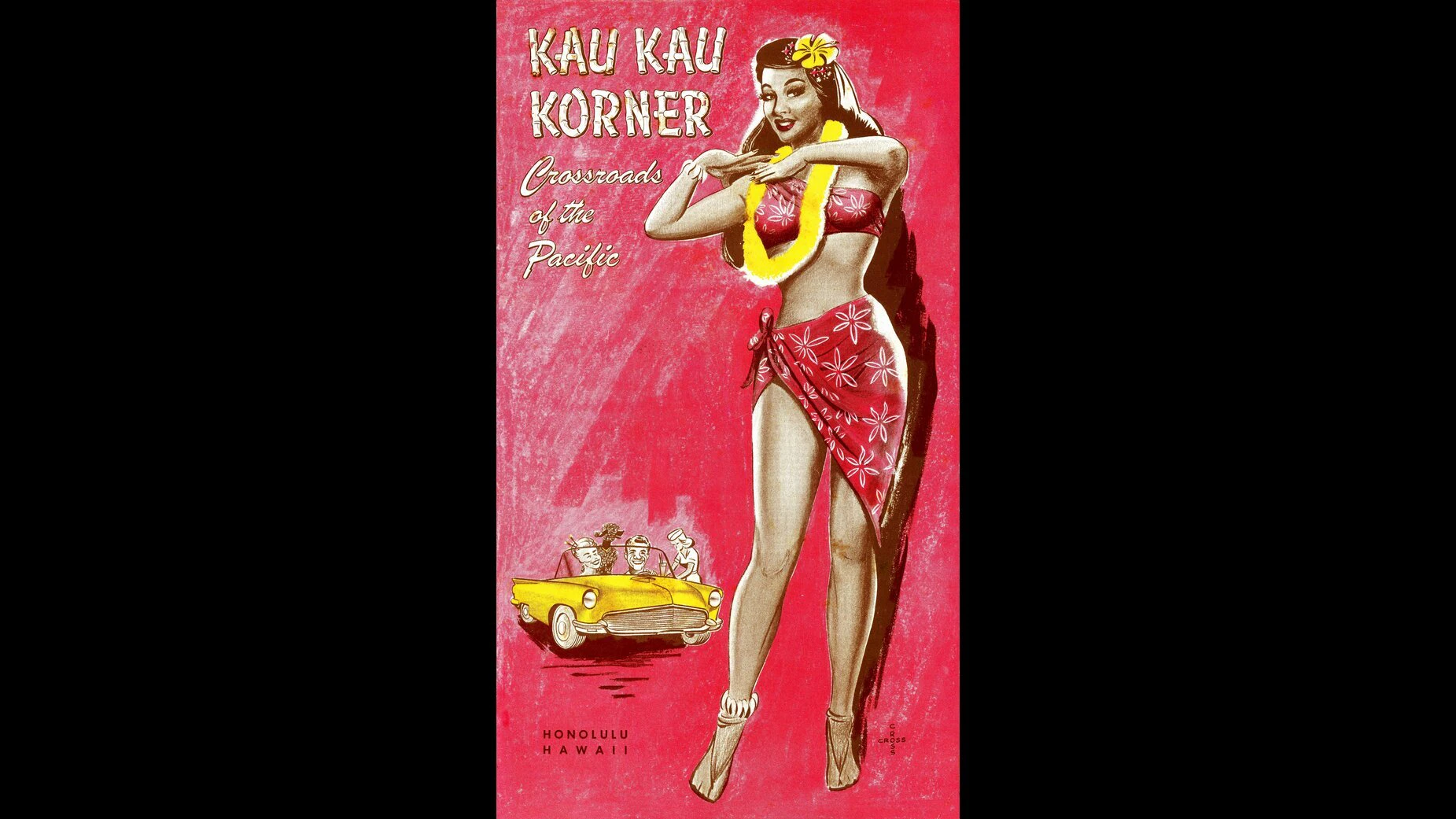

Business in this highly visible location grew enough for an entirely new $45,000 structure, occupying more leased land, to open in August 1941. Modeled after the well-known drive in restaurants of Los Angeles, this new Kau Kau Korner featured a curved glass-brick façade with a map of the Hawaiian Islands executed in sheet metal and neon lettering. On the second floor, behind the glass bricks, was Sunny’s executive office — and, for a select invited group, illegal slot machines used for gambling! There were now 40 employees, including 11 carhops dressed in snappy red & white uniforms to serve the 100-vehicle parking lot.


Immediately famous on the property was a freestanding neon sign emphasizing that Hawai‘i was the “Crossroads Of The Pacific”, the slogan lettered on the top. On the sign’s pole were wooden arrows pointing to various other locations, both domestic and international, showing how many miles away each one was. This landmark sign was a favorite subject of amateur snapshots for years.


Continuing through the 1950s, the high point of the popularity of drive in restaurants in the United States, Kau Kau Korner’s run came to an end when it lost its lease and closed in February 1960. The new occupant of this location was the successful locally owned Spencecliff Corporation, which already operated a number of very popular establishments on O‘ahu. A crash remodel and enlargement of the existing building disguised it completely and enabled its very quick reopening in September 1960 as Coco’s Coffee Shop, an example of the next big trend for inexpensive dining in America. Open 24 hours a day for a capacity of 190 diners, Coco’s served everyone from families during the daytime to weary nightlife patrons seeking predawn breakfasts. Local celebrities were among its regular patrons, especially those with late-night entertainment jobs or conversely, the ones who started their work days very early.


In turn, Coco’s reached its end on the last day of August in 1986. It was demolished the following month to be replaced by the new Hard Rock Café, which opened in July 1987 with much fanfare. This new business turned its back on the busy intersection that the previous restaurants had openly faced, and disguised this view with trees and foliage. Inside, musical artifacts from its already-famous collection of guitars and other rock memorabilia were prominently displayed along with Hawai‘i-specific historic graphics.


Most notable was the customized 1959 Cadillac suspended from the ceiling above the bar. Owner Peter Morton claimed in an interview that this vehicle had belonged to an “eccentric rancher” on Hawai‘i Island who had used it to carry his surfboards, when in fact it was a stock Cadillac ambulance that had had wooden paneling added to its exterior to serve as a prop specifically for this restaurant. The Hard Rock Café chain was the most prominent of an abundance of theme restaurants that proliferated in the 1980s and ‘90s, and it was notably popular in Honolulu, particularly for tourists seeking merchandise like its T-shirts. For years there was a line at the door waiting for entry.
The Hard Rock Café gradually lost its novelty and chose to move to a Waikīkī site on Beachwalk in November 2010, closer to the tourists who constituted its main clientele. After this, its former building hosted various short-lived tenants until the Honolulu Coffee Company opened there in September 2015, yet again an example of a current trend in American eating and drinking establishments. Their “Aloha” painted mural from 2018, facing Kalākaua Avenue, remains in place although they have moved to King Street in Mō‘ili‘ili.
And this then brings us to 2026 and this location’s newest tenant: Chick-fil-A’s sitdown-only restaurant. There’s a precedent here, which no one today will know about, in that Kau Kau Korner was Hawai‘i’s first Kentucky Fried Chicken franchise location, starting in March 1958 before KFC had opened any of its own stand-alone buildings locally. But any chain fast-food restaurant, a type invented in the USA but now international in scope, is historically in keeping with the succession of what’s gone before at Honolulu’s Restaurant Corner.
For the latest news of Hawai‘i, sign up here for our free Daily Edition newsletter.


