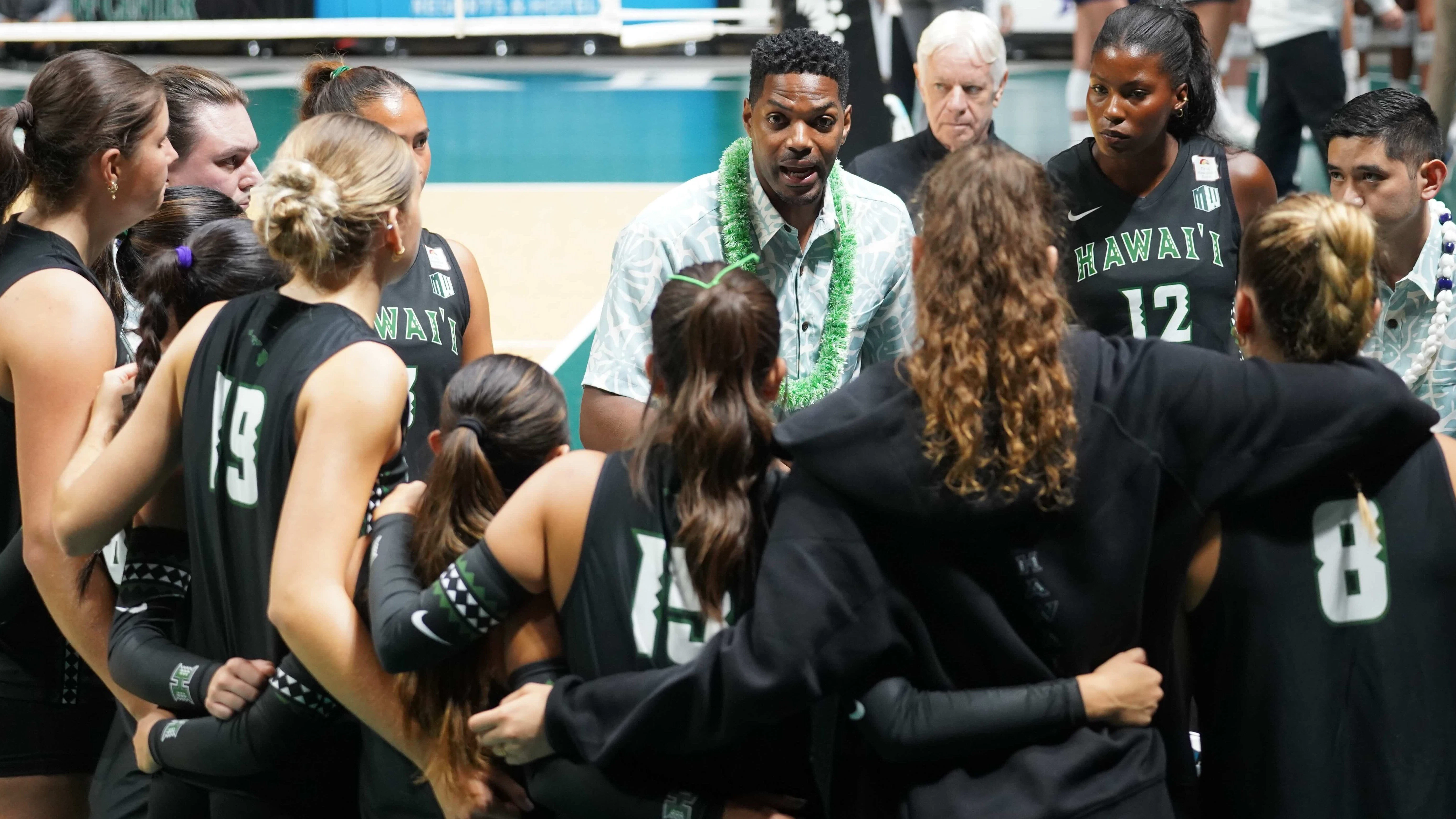
Twenty years ago, Joshua Walker graduated from Tallwood High School in Virginia Beach, Va., and embarked on a new journey.
The standout outside hitter hopped on a plane, making a 10-hour trek to the Islands to enroll at the University of Hawai‘i and play for its men's volleyball team.
Walker didn't know it at the time, but the school and state would go on to become a major part of his life. It was at UH that Walker met and married his college sweetheart, Tehane, an ‘Aiea High School graduate and former captain of the UH soccer team. Joshua and Tehane Walker currently have five children together.
After earning AVCA All-America honors with the Rainbow Warriors, Walker traveled across the globe in a professional career that came to an end in 2016 after joining Charlie Wade's staff as an assistant coach.
Walker's transition from playing to coaching was seamless, the promise he showed as a young coach evident in winning the 2019 AVCA Assistant Coach of the Year. In 2022, Walker spread his wings and joined the women's volleyball staff at Baylor University and was elevated to associate head coach in 2023.
Following Robyn Ah Mow's abrupt resignation on April 29, a surprise vacancy for the UH women's volleyball head coach position was created. A national search spearheaded by UH athletics director Matt Elliott lasted over a month, but in the end, Elliott says he was "absolutely thrilled" in offering Walker a five-year contract to become the new Rainbow Wahine head coach.
Walker, who is currently in the midst of hectic summer that involved coaching the U.S. women's national youth team, was only able to make it back to O‘ahu as the program's new head coach in recent days.
Aloha State Daily recently caught up with Walker about his new gig, the journey leading up to it, and what's next for him and the Rainbow Wahine.
Aloha State Daily: You graduated high school 20 years ago and embarked on your journey to Hawai‘i. If someone asked you back then where you saw yourself in 20 years, what do you think 18-year-old Joshua Walker would have said?
Joshua Walker: He would have said he'd probably still be involved with sports. Everybody in my life, my family, has been teachers, preachers, law enforcement, and military. I kind of fell into the teacher pot. That's what I feel like I do in coaching. It's not just about coaching volleyball, though. It's about teaching, and I'm helping them learn how to be great people and be adults. Looking back, I'd probably say I'd be involved in some kind of teaching or some kind of mentoring.
ASD: How did you find your way to the University of Hawai‘i during the recruiting process?
Walker: I just had a lot of great coaches, a lot of great people that looked out for me throughout my career. I wasn't playing volleyball that long. I started playing more seriously when I got to high school, but I was state Player of the Year by my junior year, and my coaches kind of helped facilitate me getting on some people's radars that maybe I wasn't on originally. I wanted to go to George Mason, but God had other plans. It came down to a 10-hour flight to Hawai‘i or a 10-hour drive up to Penn State, and I chose the flight. It's just one of those things where a lot of people were looking out for me, and I heard about the fan base.
The 2006 season was a pretty good season for the men's team as well, but I knew there were some people that were leaving, so I felt that was an opportunity to potentially go on court sooner than later, too. And Penn State had players like (AVCA Player of the Year and two-time Olympian) Matt Anderson that were on the roster. (Hawai‘i) was a good opportunity for me to potentially go on court a little bit sooner, and I just heard about the fanbase, so I felt I could be a player that would thrive in environments where I knew people cared about volleyball as much as I did.
ASD: If you could put your UH men's volleyball assistant coaching hat on for a second — when you were coaching under Charlie Wade, do you think you would have recruited Class of 2006 Joshua Walker?
Walker: Yes, I would have, because the thing that you kind of look for that you can't necessarily describe or be able to explain is how they are on the court and how they are off the court. The accolades have to be there, yeah, but if you're touching 11'8" (11 feet, eight inches on a vertical jump) and you can hit, it's probably someone that is going to get recruited. That being said, it would have been for sure harder for me (given the caliber of players the Rainbow Warriors have recruited under Wade) to think, OK, well, 'He's got to do this or this to even have a chance to be on the court,' but yeah, for sure it was one of those things where I think Charlie for sure would have tried to still recruit me.
ASD: How would you sum up the experience of playing pro volleyball and getting to travel the world?
Walker: I played pro in Abu Dhabi, Greece, Denmark and Finland. The team that I was on in Abu Dhabi, we went to Egypt, went to Lebanon. In between summers, I ended up going to play in Japan for a tournament. Then I played in Greece for Panathinaikos, which is a legendary club in Europe. A lot of people in general know what Panathinaikos is and the rivalry they have with Olympiacos, so that was pretty cool being a part of that rivalry. Denmark was unique because that was the first time I chose where I really wanted to go. I didn't really go through an agent or anything because I wanted a place where I was gonna be happy and have a good season. I ended up getting MVP there, won a couple championships there, so that was just really fun. Finland was probably the best combination of everything, from quality of life off the court, how good the league was overall, there were seven or eight other Americans that were in the league at the time, so every time we were playing another team, there was someone I knew. It was just a really great experience, being able to play and travel all over the world because of volleyball.
ASD: When did you decide to become intentional about wanting to become a coach, and what was that process like?
Walker: I initially did not (want to stop playing) at first because my daughter was being born and I had an opportunity to go back overseas. A position (under Wade) opened up here. I told Charlie, OK, we can try it out for a year. If I like it, great. If I don't, then I know I can go back and play pro. When I got into it, I wasn't sure how it was going to go. After the first year, I was completely hooked. I knew there's so many different things we could do that's going to help us be more successful. I knew how to relate to the guys here since I had just relatively been through it, and they were coming off (an NCAA Tournament appearance. ... The team had some good pieces that were leaving, and the team that I was able to be there with, guys like Kolby (Kanetake), Siki (Zarkovic), and those players, they were great for me, just to kind of have an experience, like, OK, I can help these guys accomplish their goals here and what they want to do. I think that just kind of bled into the next year, and in 2018 we had a good season, a disappointing ending (UH did not receive an anticipated at-large bid to the NCAA Tournament). But if we don't have that '18 season, we don't have the '19 season in which we blew a bunch of records out of the water. If you don't have the '19 season, you're not able to have the '20 season. If you don't have the '20 season, you're not able to finish the job in '21 and then couple that with a relatively new group in '22 (and a repeat national championship). So, every year just kind of built off of itself.
ASD: Did you go to a lot of Wahine volleyball matches when you were a UH student?
Walker: Yeah, for sure. ... Absolutely. Went to the games, supported them. Some of my best friends still to this day are Wahine volleyball alumni. To me, it's just kind of a full circle moment. When I'm out recruiting or just seeing these players that have gotten in different aspects of their life or still connected to volleyball, still being able to stay in contact with them and just how excited they are that I get the opportunity to come back and coach. I have a great relationship with Ryan McGuyre at Baylor, his wife (Jennifer Roberts McGuyre) was a former Rainbow Wahine as well. They're just all over the place and all very supportive. I'm looking forward to the opportunity to give back but also to have my friends just be proud of their university.
ASD: When you were sitting in those crowds, if someone told you that you'd be running the show one day, how do you think you would have reacted?
Walker: I'd be like, 'OK, I don't know what you're talking about right now, I'm just here to get better at volleyball.' It's not something that really crossed my mind. You just feel like God really has his hand on my life, and I can't pick out the situations and the opportunities that have come up because I couldn't plan this out myself. I just know somebody else has their hand all over it, and that being said, I feel like I'm prepared for this moment. ... At the time, I was just focused on doing the best I could, being the best teammate I could be, being the best son I could be, being the best brother I could be, and now that's kind of blossomed to 20 years later and getting an opportunity to be the head coach.
ASD: How did you and your wife meet?
Walker: Oh, gosh. I knew of her because the soccer team was pretty good when I was here, as well. Obviously, UH athletics was pretty dominant when I was here. Football was doing great, making the Sugar Bowls and all that. It was a great time just to be at UH in general. My wife, I knew of her just because she was on a great soccer team and a good soccer player. I didn't really get out to Waipi‘o (Soccer Complex, home of UH soccer) that much. ... I actually made it out to watch one of the games. I knew a bunch of players, but it wasn't until she had already graduated. Even though we're the same age, she was a better athlete, and she was smarter than me. She had graduated and she didn't redshirt. She was working at Duke's. We had a recruit (on a visit), and we went down to Duke's, and she was one of the hostesses. Our eyes just met, our eyes locked, and it was one of those things I can't explain. It was that moment, and then we just kind of followed up with each other, we got each other's contacts, and that's kind of how it got started. That being said, I was going into my junior year, and volleyball was pretty high on my priority list. We had this joke early that we would see each other 1.5 times a week because of our schedules. She was getting a master's at Chaminade at the time, so any time we got to see each other, it was great, and we enjoyed being around each other. But outside of that we both had other things we were focusing on."
ASD: When you think about the journey you two have been on over your career, how special is it to be able to come home to Hawaiʻi with her?
Walker: It's one of those things where it's like, OK, you marry a local girl, you're not gonna leave (laughs). She's always been super supportive of me and my career and everything that I've wanted to do, and obviously, a big priority was just making sure my family's quality of life is great. To me, having a chance to go to the women's side wasn't necessarily just because there's more opportunity, it's also a chance to experience something different.
A lot of women in my life have given back to me and have been very influential between my mom, my sister, who helped me get into the sport. My first coach, Angela Hubner, as well. There's just a lot of great women in my life that poured into me, and it was a chance for me to get to the women's side and pour it back into them, and that opportunity came up. ... So, I'm like, I might as well get some experience on the women's side, just in case something happens, and that was kind of the mindset leaving. I might have a chance to come back, but Hawai‘i will always be home, it's just whether it's my workplace again.
ASD: When you were an assistant coach with the men's team, you were often seen playing with your kids after the matches. What does having them be a part of the journey mean to you and how has that balance been?
Walker: Everybody says balance, balance, balance. One of the questions I had early in my coaching career was how do I balance this? It's really not a balance, it's when I'm doing my job, I'm 100% focused on that, and then when I'm doing family stuff, I'm 100% focused on that. So, I don't balance it out. When I'm done working and I know it's family time, I make sure that I'm spending time with my family when the game is over. They love going to sporting events which helps. It's very great that they like doing that. They're in it as much as I am. They love volleyball as much as I do. They love sports as much as I do. ... I'm just very appreciative for my family, for them helping the environment, and helping them fall in love with volleyball as much as I have.
ASD: What was your reaction when Robyn Ah Mow stepped down? When did you consider going for this job in the aftermath?
Walker: Going into May, I was doing USA stuff. I had two weeks where there's stuff I have to do, but not over the top where I'm going to be super busy. All of a sudden my phone starts going off, and I'm like, what is going on? Everybody's saying, Robyn's stepping down and you should apply, that kind of stuff. I'm like, OK, I'll think about it. I was in a great situation at Baylor, so I didn't feel like I needed to leave, but it had to be for the right opportunity. Even though it is a great opportunity to be the head coach of Wahine volleyball, things have to line up, it has to make sense. I had to talk to people that I'm really close to, had to pray about it, all those things. If I'm taking the job now, how will it look like the very first day I'm on the job? Depending on when that happens and what the priorities need to be, and all those kind of things. It didn't take long for me to kind of go through the process, because that's what you do as an assistant coach.
If a job opens up that you're interested in, you're going to apply. It's just one of those things, which, realistically, the path for you to be on the same page with all the people involved in the process and those logistics, it doesn't always work out clearly. It's one of those things where, I knew I would be prepared for a yes. I'd be prepared for a no. Being in coaching, you get told no a lot, and then you get a few yeses, and you hope those yeses make the difference.
ASD: Now that you've got to be a head coach for a few weeks, how has the experience been so far?
Walker: It's been busy. There's been a lot of stuff to get done. Last Monday (June 15) was a huge one, one of the biggest recruiting days of the year. Getting things organized for that takes a lot of time, but I think we did a good job considering how fast we had to turn things around, and try to get focused on, OK, who actually wants to come and can help right away, and then just meeting with the current team, which was great. Having time to meet with all of them individually was great, and definitely want to do that again before everybody gets back on campus, just to once again kind of get to know them and make sure we're on the same page as far what their dreams and what their goals are. ... The focus is on the team. Obviously coming off of a rough situation losing their coach, but we're gonna make sure we do things to make sure we define what winning is, and that we can have a successful season going forward.
ASD: As it relates to the changes in college sports, how do you feel about the resources you have here compared to a place like Baylor?
Walker: You'd be surprised. The things that we have here is what you need to be a high-level athlete. I went through here and went through the university, and I had the resources I needed. The biggest difference I feel between a power school and a Group of Five school is just the amount of people that you have working. You can have more people, that doesn't mean you're necessarily going to have higher quality people either, and yes, there's going to be a difference in facilities. You're at those schools, they're always talking about what the other school has and what the other school has, and in the end, you can be on a team and want to start. You can be honest, you can be a starter and want to be All-Conference, All-American. If you're competitive and you want to win, you're always going to want more, so you can't dumb that down.
Yes, at the University of Hawai‘i, we want more. We want to have the nicest things, but in the end, you have what you need to be successful, and in the end, if you have that, let's go. Let's go and use it. So, the resources for volleyball in particular are pretty comparable across everybody across the nation, so that's what I'm excited about. The reason why we've been successful is because people know how much people care about Hawai‘i volleyball. I know whatever resources or things that we need, there is a way to get it, especially if I'm doing my job as coach.
ASD: So, maybe you didn't imagine yourself in this seat 20 years ago. How about 20 years from now, how do you think you'll look back at this time in your life and your family's life?
Walker: I do not know. Once again, I'm so focused on what's happening right now and then maybe within five years what it could look like. But I just know from seeing what it takes to get a program to where it needs to be, the goal is to be able to win national championships again. It takes time, so to me, it'd be great in 20 years from now we're talking about, man, we're national champions, and this is the path that it took to get there, and all the lives that you helped influence and helped impact on the way that's led to that moment. I think that would be nice in 20 years to think about, to reflect on that part, but got a lot to get to and a long way to go.
Christian Shimabuku can be reached at christian@alohastatedaily.com.
For the latest news of Hawai‘i, sign up here for our free Daily Edition newsletter.