Hawai‘i has a big environmental problem. It’s real. It’s poisoning the land and the ocean every single day. We’ve passed a law to fix this problem by 2050, but we are way behind schedule while the poisoning continues.
Climate change?
No. Crap.
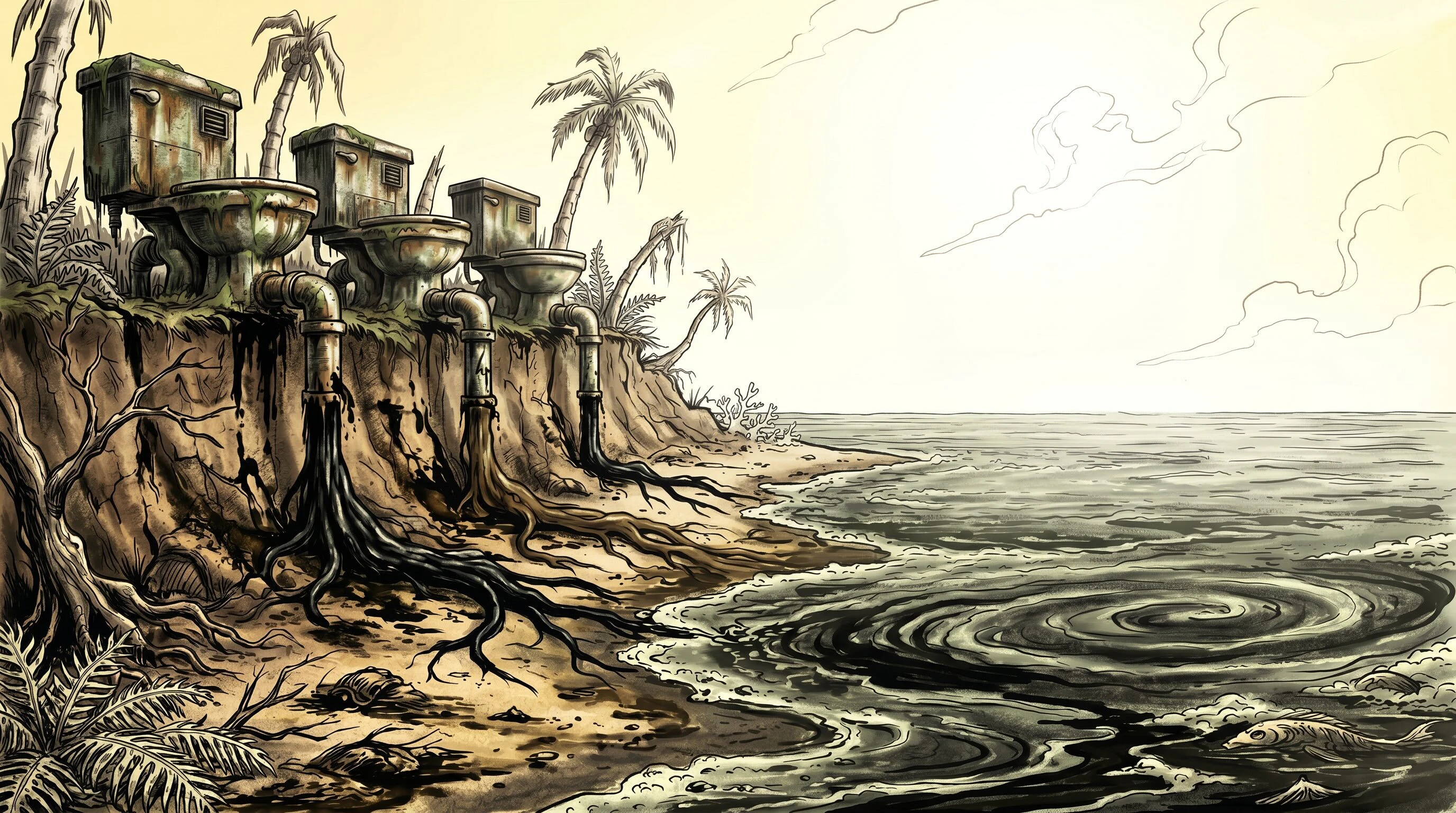
Actual, literal human waste, leeching into our ‘āina and our groundwater from Hawai‘i’s 88,000 remaining cesspools.
For the gory details, see the state Department of Health’s cesspool page. Short version: Of the 88,000 cesspools statewide, 43,000 “pose a risk to our water resources.” It adds:
- “There are approximately 6,700 cesspools that are located within 200 feet of a perennial stream channel throughout the state. There are approximately 31,000 cesspools that are located within the perennial watersheds on the islands of Hawai‘i, Kaua‘i, Maui, and Molokai.
- “Cesspools in Hawai‘i release approximately 53 million gallons of untreated sewage into the ground each day.
- “Cesspools have a significant impact on the quality of drinking water, general water quality, the health of our reefs, and the health of Hawaii’s residents and visitors.”
The problem is so bad that Hawai‘i passed Act 125 in 2017 to eliminate all the cesspools by January 1, 2050.
But we’re only removing hundreds per year when we need to be removing thousands. Earlier this year, as reported in Civil Beat, the mayor of Hawai‘i County, Kimo Alameda, has asked for an extension to 2060. This is significant because most of the state’s cesspools — 50,000 of them — are on Hawai‘i Island. They are mainly attached to private homes and businesses and the cost of eliminating a cesspool can be ruinous for homeowners. Civil Beat notes that state created a $5 million grant program in 2022 that offered $20,000 each to low- and moderate-income property owners for cesspool removal.
The money ran out “within a week of the grant’s launch.”
There could be some relief from the state’s new “green fee,” but as of that February article, the amount discussed was $1 million.
Just one million. The “green fee” fund has $120 million in it, for this year alone. If it takes $20,000 to kill a cesspool, that’s 6,000 cesspools per year. The most dangerous 43,000 cesspools could be eliminated in little over seven years. If we started in 2027, we’d be done by 2034, a staggering 16 years ahead of schedule.
That’s 16 fewer years of human sewage, dumped into the land and seas by the tens of millions of gallons.
Here’s what’s happening instead. When Act 96 went into law last year, it levied a tourism “green fee” tax that generates the green fee fund. With seemingly little regard for actual environmental priorities, the Act predetermined that the funding would be split equally between the nebulous categories of “Sustainable Tourism, Natural Resource Stewardship, and Climate Resilience,” according to the Care For ‘Aina Now coalition.
Somehow, that coalition seems to be in charge of connecting Hawai‘i businesses and nonprofits with state government. This week, Care for ‘Aina Now held the first of its statewide virtual workshops to advise these entities on how to apply for green fee funding.
The funding decisions will be made by just 10 people on the Green Fee Advisory Council.
They are Eric Co, CEO, Harold K.L. Castle Foundation; Lea Hong, Hawaiʻi State Director of The Trust for Public Land; Dennis Hwang, faculty, University of Hawaiʻi Sea Grant College Program, NOAA; Janice Ikeda, founding CEO of Vibrant Hawaiʻi; Michelle Kaʻuhane, chief operating officer and executive vice president at Hawaiʻi Community Foundation; Jack Kittinger, conservation scientist and Research Professor at Arizona State University; Keoni Kuoha, long-time Hōkūleʻa crew member and Maui community leader; Carmela Resuma, destination stewardship director at Kilohana by the Hawaiian Council; Jeff Wagoner, president and CEO of Outrigger Hospitality Group; and council chair Jeff Mikulina, executive director of Climate Hawai‘i.
What we’ve got is a clique of environmental careerists, connected government insiders and one tourism executive who are going to take the enormous power of $120 million per year and dilute it through some unknown number of disconnected projects.
Let’s aside the opportunities for graft this process represents — friends handing friends tax dollars. Let’s set aside the possibility that some of these projects will have some merit in and of themselves — some wildfire mitigation here, some shoreline hardening there.
It just seems typical of why nothing ever seems to get better in Hawai‘i. No focus. No ability to just pick a single big problem and solve it, even when we obviously and easily could.
The purported threats to Hawai‘i stemming from climate change may never even come to pass, and the problem certainly wasn’t generated here. The poop, on the other hand, happens every single day and we made that mess for ourselves, 100%. We know exactly what it’s doing to the environment. We could end the cesspool problem once for all, ahead of schedule, with all this money.
So, of course, we aren’t. Come 2050, we’ll still be talking about the cesspools while, by then, some $2.8 billion in green fee funds will have been spent on who knows what else.
I’d bet money on that outcome, because the State of Hawai‘i certainly has.
A. Kam Napier is editor in chief of Aloha State Daily. His opinions in Pipikaula Corner are his own and not reflective of the ASD team.
A. Kam Napier can be reached at kam@alohastatedaily.com.
For the latest news of Hawai‘i, sign up here for our free Daily Edition newsletter.