

When you’re on vacation, you can cut loose a little bit. This attitude explains why tourists in Hawai‘i can be susceptible to renting vehicles they’d never consider otherwise. Partly this can be due to the benign weather that requires less protection from nature, but it’s also just the vacation mindset. Let’s look at a few of the kooky rental cars that tourists went a little crazy with in the past.
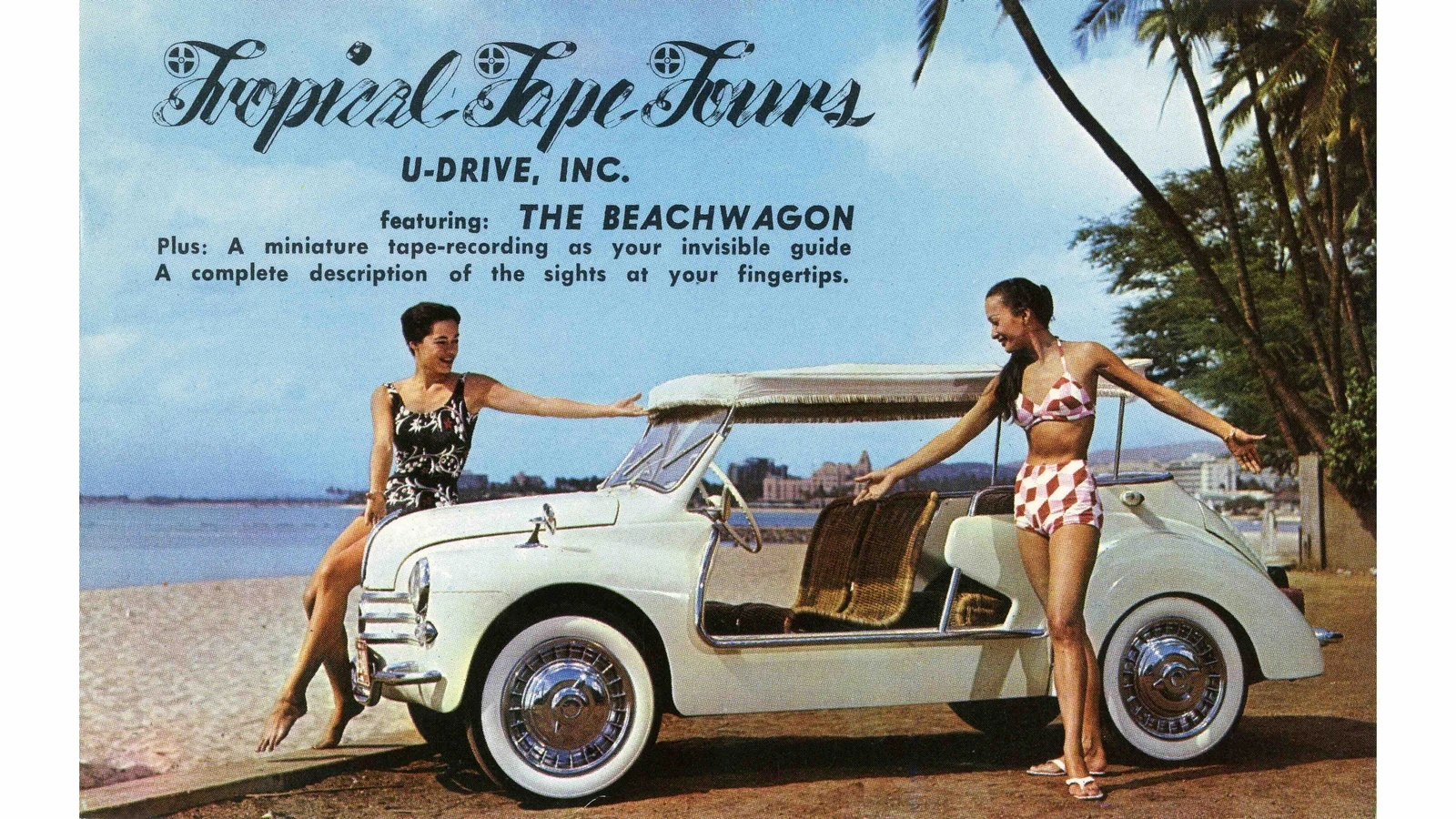
Back in 1947, French auto manufacturer Renault introduced its 4CV model, extremely small and as low-priced as possible for a country still economically depressed from the effects of World War II. In late 1959, as this model neared the end of its production run (which would come in 1961), Renault provided 50 of them to the Italian custom auto body builder Ghia to create what was called the “Jolly” — a completely stripped-down machine with no doors or windows, a fabric top and wicker seats woven onto metal frames.
In the USA, the Jolly was renamed the Beach Wagon. A Honolulu company bought a “fleet” of them - no number specified, but perhaps five or more - and provided each with a small plastic portable tape recorder. Tourists who rented one of these from Tropical Tape Tours had a choice of four different O‘ahu tours to accompany their drives, with a map showing numbered locations where the tape should be turned on for an audio description. Ads described the vehicle as “The car with a voice / Takes you where you want to go / Tells you what you want to know.”
Tropical Tape Tours functioned from at least May to December 1961, when one of its Beach Wagons sustained an estimated $200 in damage when another car being parked nearby jumped a curb and landed on the Renault that was located at a slightly lower level, knocking it on its side.

With only 50 Renault Beach Wagons made, survivors today are extremely rare and sell in the range of $50,000 if they show up in specialized car auctions. Very similar customizations by Ghia of both the Fiat 500 and 600 models, from Italy, look confusingly similar to the Renault at first glance. The Fiat 500 Beach Wagons were definitely also sold and driven in Hawai‘i. While these Fiats are also desirable collector vehicles they’re a bit more common since 650 of them were manufactured. And at least one American company today rebuilds original vintage Fiats to the same look as the historic Beach Wagons.


The Jeep started its life as far removed from carefree fun as possible, since it was invented as a purely military vehicle for use under tough conditions in World War II in the early 1940s. Driven in both Europe and Asia, in situations from bitter cold to steamy heat, the Jeep became immediately famous as a symbol of the American military. Millions developed a real affection for it, and back in postwar civilian life the Jeep moved successfully into a specific workhorse niche.

The Willys-Overland Corporation of Toledo, Ohio, formerly a small manufacturer of standard passenger cars, shifted in the 1950s to focusing on the Jeeps it had been manufacturing since World War II. One of the company’s salesmen in its foreign / export division encountered distinctively-painted Jeeps at the Las Brisas resort in Acapulco, Mexico and thought Willys might make similar models in bright colors for use in warm-weather vacation spots.
In 1959 this came true with the Jeep Gala, a no-frills model painted green, blue, or pink (by far the most popular of the three colors) with striped vinyl fabric upholstery and a similar top trimmed with a fringe. Hawai‘i seems to have been this car’s first major market with the first 10 cars arriving in late May 1959 to be sold by VHY Motors to Avis Gray Line rental cars. The distinctive and unique pink Jeeps immediately attracted much attention and were instantly popular with tourists, so in succession 40 more were ordered by Avis, then 10 more, and finally 20 more to arrive in January 1960, which included a few blue ones. By September ‘59 the Gala models had spread to Cuba and the Virgin Islands. For some reason, even though Hawai‘i had just become the 50th state, Willys handled these sales through their export division under the Gala name while Jeeps sold to the other states were marketed as the Surrey. The latter name was a reference to the popular song “Surrey With The Fringe On Top” from the 1943 musical play “Oklahoma!” which had been made into a well-publicized big-budget Hollywood film in 1955. Like the horsedrawn vehicle in the song, the Jeep Surrey also sported a fabric fringe around the edge of its vinyl fabric soft top, adding to its carefree spirit that so many tourists were attracted to.
During this period, the extremely wealthy industrialist Henry J. Kaiser was being heavily publicized for his development of the Hawaiian Village Hotel in Waikīkī, which he’d started in 1955. Everyone locally knew that Kaiser’s favorite color was pink, and even the heavy equipment that began building his Hawai‘i Kai subdivision in 1960 was painted that color, so it was assumed that the pink Jeeps must be his doing. This idea was bolstered by Willys having been one of his subsidiary companies since 1953 — but newspaper stories in 1959 made it clear that Kaiser had no personal involvement in the Jeeps, nor were they exclusively available at his hotel.
Approximately 1,083 Jeep Galas were manufactured from 1959 through 1964, and probably the greatest number of these ended up in Hawai‘i. Their moment in history was brief, but memorable.


For decades, people took apart old cars and assembled elements into vehicles they could utilize for farm chores, or for driving on private land and not public roads. In the 1960s this same urge created what we soon came to know as the dune buggy, for fast and fun driving on sand dunes and other off-road activities. Unlike most vehicles, dune buggies were not made in factories but instead came from very small assembly companies, or were put together by private individuals using parts provided as kits. The first such vehicle was the Meyers Manx, invented in 1964 by a Californian who established the dune buggy template of a new, custom fiberglass body mounted onto a used Volkswagen Beetle chassis. Equipped in most cases with pretty much just a windshield and seats, the dune buggy exposed drivers and passengers to exhilarating wind speeds and a ride low to the ground that seemed faster than it was.
The rental companies in Hawai‘i that offered dune buggies in the 1960s and ‘70s probably never authorized customers to drive them off-road in the way the vehicles were originally invented to be used. What a renter got was a sporty-looking car to attract some attention while driving at regular speeds on the same public streets that everyone else drove on.


In the late 1950s, the British Motor Corporation attempted to create a specialized vehicle for military use, likely inspired by the success of the Jeep 20 years earlier. What they came up with was never suitable for military use, however, being too small, light and underpowered. So instead the company repositioned the Mini Moke, as it came to be called, for possible light commercial needs or, more reasonably, recreational use. Made in Britain from 1964 through 1968, the Mini Moke gained a following during the period when anything British was considered automatically cool and desirable. In the following decades it was assembled in Australia, Portugal, Malaysia, Africa and Italy in various iterations, followed by unlicensed versions in China beginning in 2013. The Mini Mokes first used as rental cars in Hawai‘i likely were from the earliest batch, made in England. Surprisingly, today you can again rent a Moke in Hawai‘i, only this time they’re electric and are again from Britain, like the originals were. This is a little machine that seemingly will not give up!
In retrospect, the lack of safety, protection or security in these old-time vehicles is hard to believe. A total absence of doors and windows, not to mention cloth tops with no metal strengthening, are frighteningly unsafe. No seatbelts, headrests or airbags would mean occupants would be thrown against any part of the interior at high speeds in a collision, or — even more likely — would be tossed completely out of the vehicle (which commonly happened). Even just walking away from one of these when it was parked would expose anything left behind to instant theft … and yes, even back then there were robbers waiting around tourist spots to grab unattended purses or wallets.
But when you’re on vacation … the real world can be ignored, or so we sometimes think.


