

Hawaiian Council presented its 25th annual Native Hawaiian Convention from July 20-22 at the Neal S. Blaisdell Center in Honolulu, where more than 2,500 registrants including 300 keiki enjoyed cultural workshops, panel discussions, breakout sessions and more.
The convention, which attracted hundreds of attendees from the Mainland to Oʻahu, aimed to focus on community advancement and cultural pride, according to Hawaiian Council’s CEO Kūhio Lewis.
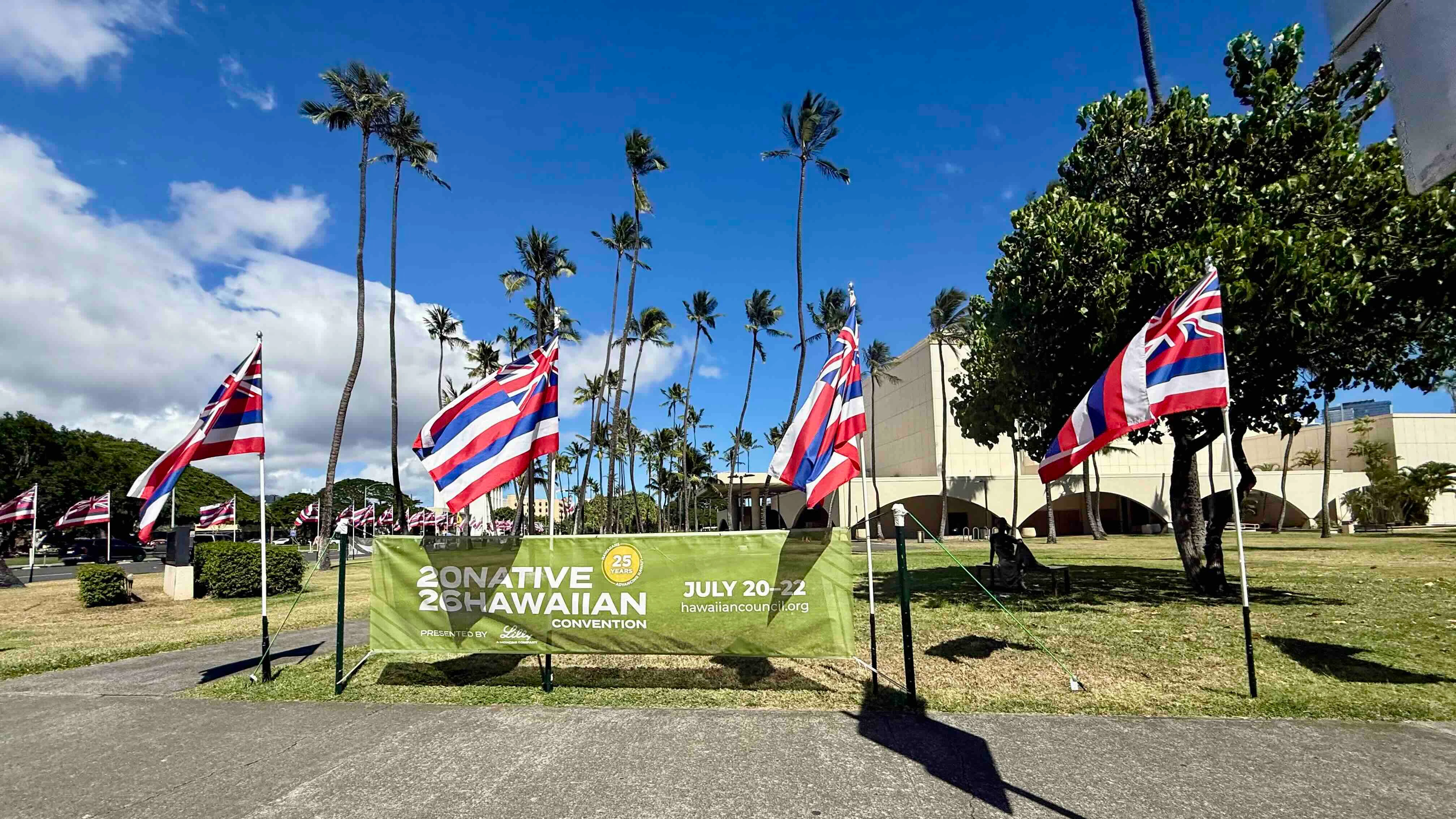
It also marked 133 years since the overthrow of the Hawaiian Kingdom under Queen Liliʻuokalani. He noted that for the first time, 133 State of Hawai’i flags were posted around the perimeter of the Blaisdell in remembrance of that day in history.
“Symbolically, it represented our kūpuna that came before us,” he told Aloha State Daily.
Lewis added that three principles — past, present and future — guided its events: Hoʻolōkahi (to make peace), Hoʻokūpaʻa (to stand firm), Hoʻoholomua (to move forward).
“What I wanted when we conceptualized the convention is [for] Hawaiians to feel a sense of pride,” Lewis said. “I wanted them to feel a sense of elevation. Oftentimes, people perceive us as having limited capacity or in grass shacks, but we’re so much more than that and bring so much more to the table.
“It was really to create a sense of place that everybody felt comfortable; it felt elevated. It felt very Hawaiian, very Hawaiʻi, and that was important for us. It wasn’t just another convention. It was the future of where we’re going as a people.”
Walking through the front entrance, attendees were greeted with screens transporting them across the Islands (Note: Hawaiian Council owns Hawaiʻi Stage and Lighting). One side of the room was conducting live breakout sessions complete with headsets, while the other led to a shopping experience by Nā Mea Hawaiʻi, which is owned by Hawaiian Council and currently operates the gift shop at Bishop Museum. There, you could shop locally made products, vintage alohawear and muʻu, jewelry and accessories, and lounge on furniture, or play games on lau hala mats surrounded by tropical plants, hanging ipu, a canoe display, and more.
Sponsor booths and resources were also available on the first and second floors including Lilly Clinical Trials, Alzheimer’s Association Hawaiʻi Chapter, The Institute for Native Pacific Education and Culture (INPEACE), Kamehameha Schools/Kamehameha Publishing, Department of Hawaiian Home Lands, Office of Hawaiian Affairs, among other organizations.
“When you have a convention and the convening of out community, you want to make sure the resources that are in place are available and have a space (for attendees),” Lewis said.
According to him, there were approximately 200 staff and volunteers who helped make this yearʻs convention possible.

New this year was the use of headphones, which Hawaiian Council rented from a Mainland company, to conduct simultaneous talk stories in the open space at the Blaisdell Exhibition Hall.
“The headsets were our way of trying to figure out how to utilize the space, so we looked up technology that existed and brought them in from the Mainland,” Lewis told ASD. “You could change the channel and listen to different breakouts or even a station dedicated to Hawaiian music. All the way around, we utilized technology.”
“Everything went really smoothly, even with the headsets, they all loved it. I think it was engaging,” he continued. “There were no major incidents at all.”
Upon reflection, Lewis shared a few of his highlights from the convention like the last-day panel of the four county mayors moderated by Gov. Josh Green; breakout sessions discussing Hawaiian trusts; ʻāina and Artificial Intelligence; energy and economic sovereignty; and Indigenous gaming models, among others.
But something Lewis is most proud of is providing space for keiki to learn and grow, while selling their locally made products and showcasing their talent through dance at the Queen Liliʻuokalani Keiki Hula Competition, which Hawaiian Council hosted from July 23-25 at the Blaisdell.
“The last day of convention got converted into this massive marketplace where there were about 90 vendors, so all those chairs where the headsets were got put away and kids were selling out of their products,” Lewis said, adding that there were “a lot of innovation and cultural” items for sale such as jewelry, food and drink — and even a booth for pets and animals.
“The next generation is what our focus needs to be on. Living in the moment only gets you so far but by investing in the next generation — whether they’re entrepreneurs, or practitioners, CEOs, leaders — they’re all aspiring to go somewhere. We have a responsibility to help support them. All of us were supported at some point along our journey, so it was important to me that we use the convention help that upcoming generation.”
The spirit of aloha, he says, was displayed with a special exhibit called the “Executive Closet,” where local CEOs donated their wardrobe for kids entering the workforce.
“We collected over 600 shirts and dresses from Sig Zane, Manaola, Reyn Spooner, etc., and we sold them for $20 to the next generation of kids. They walked away with designer clothes for $20, and so, it was cool because the next day, I would somebody running around with my (old) shirt. Everybody put in to help the next generation.”
He said that the keiki hula competition “is more than hula. It’s leadership development.”
“Those kids are going to be leaders; they’re learning confidence, skills, discipline. They’re learning how to become the next generation of Hawaiian leaders,” he noted, adding that he was inspired by their discipline and focus.
Looking ahead, Hawaiian Council plans to debrief from the eventful week and continue to solicit feedback via its attendee surveys. It will look to continue celebrating its 25th year with a “birthday party for the organization later this month,” per Lewis.
He teased that Maui may be the next host site for the Native Hawaiian Convention in 2027, though, planning for next year’s convention and hula festival likely won’t start until next month. The convention was last held in Maui in 2023, according to the organization’s 2023-2024 annual report.
Hawaiian Council’s mission is “to enhance the cultural, economic, political and community development of Native Hawaiians.” The nonprofit organization also operates a loan fund, delivers capacity building services and fosters leadership development, among other programming.
For more information about Hawaiian Council, click here. Interested in more local opportunities for keiki? Check out keikirise.com.
Kelsey Kukaua Medeiros can be reached at kelsey@alohastatedaily.com.
For the latest news of Hawai‘i, sign up here for our free Daily Edition newsletter.


