
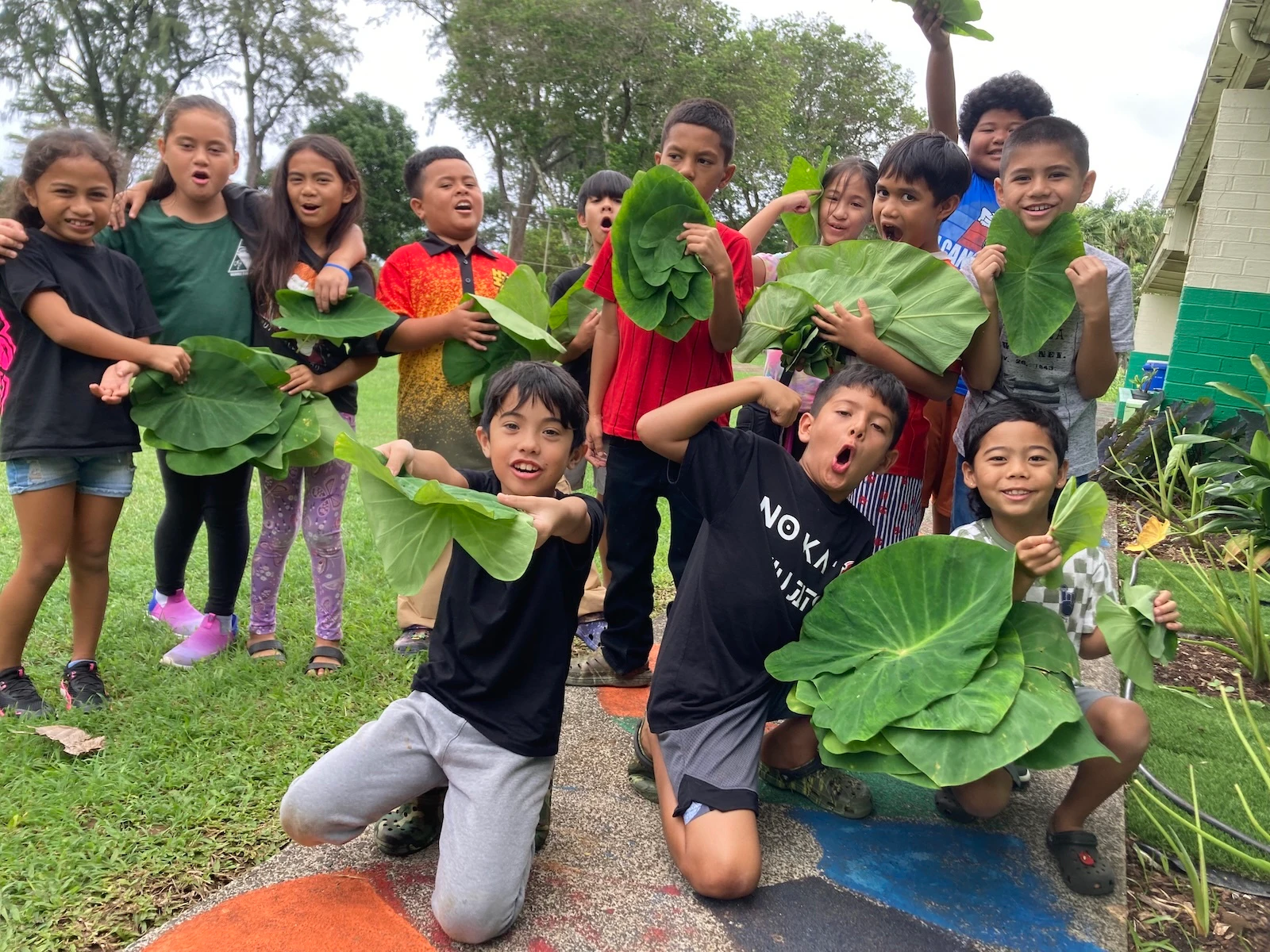
A statewide initiative that brings local crops into classrooms, culinary schools and communities is growing.
The Hoʻopili ʻAi program connects educators, students and families with nutritious Hawaiʻi-grown foods such as ʻulu (breadfruit), kalo (taro), ʻuala (sweet potato) and more through free educational resources, classroom activities and farm-to-school sampler boxes.
As part of the state Department of Education’s Farm to School Plan, the program is facilitated by Hawaiʻi ʻUlu Cooperative, in partnership with the Hawaiʻi Farm to School Network, Chef Hui, the University of Hawaiʻi College of Tropical Agriculture and Human Resilience, and the Hawaiʻi Agriculture Research Center. DOE aims to serve 30% locally sourced food across public schools by 2030, create on-campus gardens and teach students about agriculture/nutrition.
“Hawaiʻi Ulu co-op is an important partner of ours in farm-to-school education, helping our keiki learn to enjoy our Native and canoe crops. And so, by having these boxes that go to the classrooms with different agricultural products, and ʻulu in particular, it helps to forge connection for the kids between what their learning in the classroom and what they are experiencing in the cafeteria,” said DOE School Food Services Branch Administrator Anneliese Tanner, who is among the team developing new menu items at school, including ʻulu-kalo hamburger stew and loco moco with ʻulu gravy.
For Hawaiʻi ʻUlu Cooperative, the goal is to continue reaching more keiki with nutritious local foods while supporting Hawaiʻi's farmers and strengthening farm-to-school education.
Since 2022, the program has distributed more than 25,600 pounds of local food to a total of more than 115,500 students, resulting in a $278,000 reinvestment back into local ag. During the past school year, approximately 66,025 students took part in the Hoʻopili ʻAi program at 134 schools across Hawaiʻi Island, Oʻahu, Maui, and Kauaʻi — which nearly tripled the number of students served year-over-year, according to a new annual impact report.
When asked what was done differently this past school year to scale the program, Hawaiʻi ʻUlu Cooperative said one change was incorporating more of its value-added products, like ʻulu pancake mix and ʻulu animal cracker. (ICYMI: ASD toured Diamond Bakery last year to see how these products were made. Read that story here.)
“In addition to expanding the product options available this year, which made supply more consistently available, the funding we received from Stupski Foundation was much larger than anything we’d received in the past. This was critical in enabling program expansion,” says Dana Shapiro, CEO of Hawaiʻi ʻUlu Cooperative.
While educators can technically purchase boxes for their classrooms, they rarely have the resources to do so, she said, adding, “Demand for the program has always outweighed available funding to offer free boxes. All schools in Hawaiʻi are eligible, and when funding allows, we extend the opportunity to other types of educational programs (intersession and summer camps, homeschool groups, etc.).”
The Hoʻopili ʻAi program's free food boxes, complete with educational videos, recipes and classroom resources, are supported through grant funding; however, distribution is currently paused as funding is renewed.
Shapiro told ASD that the last round of funds was depleted at the end of September, so fundraising to continue supporting the free boxes is underway.
“Boxes can be purchased or sponsored directly through our website in the meantime. Hopefully more funding will be available to meet the overwhelming demand in early 2027.”
Comprised of more than 230 member farms, the co-op aggregates, processes and markets ‘ulu, along with other Hawaiian-grown canoe crops, “to strengthen local food systems and improve community health,” according to its mission.
National Farm to School Month occurs in October, though, programs run throughout the school year. To learn more about Hoʻopili ʻAi, click here.
Kelsey Kukaua Medeiros can be reached at kelsey@alohastatedaily.com.
For the latest news of Hawai‘i, sign up here for our free Daily Edition newsletter.


