
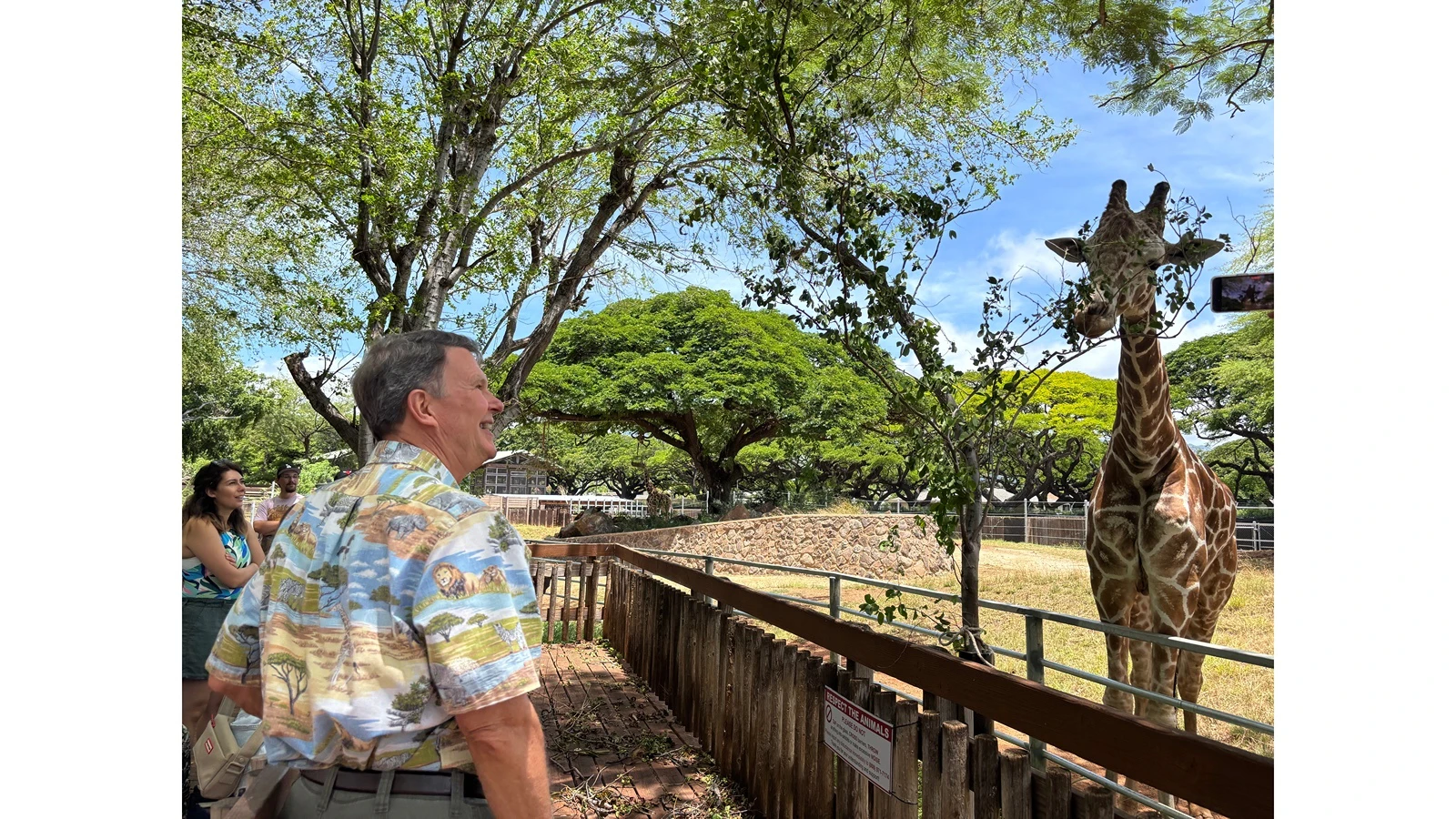
John Berry says he loves his job, and it shows. He walks around the zoo greeting visitors, the 90-person staff and the 992 animals with a big smile.
Berry enjoys introducing visitors to Pono, the 5-year-old laid back Linnaeus’s two-toed sloth. Pono sleeps for about 20 hours a day and loves apple, sweet potato and pear.
“He’s the most mellow animal in the zoo. He takes everyone to a zen place,” Berry said. “If there’s a surfer dude in the collection, it’s Pono.”
Berry said that each animal at the zoo has its own personality.
Berry fell in love with wildlife at the Smithsonian National Zoological Park in Washington, D.C. He remembers the Asian elephant Ambika, who came to the National Zoo in 1961 and said that it was like they grew up together.
“I have a special place in my heart for the elephants because of that,” he said.
Carmen Turner, former general manager of the Washington Metro, mentored Berry when he worked as a legislative director for Congressman Steny Hoyer in his 20s, and when she asked what Berry's dream job would be, he said that it would be to serve as director of the National Zoo. Turner told him to hold on to that dream, “because life has a real funny way of taking you places.”
In 2005, the National Zoo was in hot water over animal deaths and alleged mismanagement. Berry had been leading the National Fish and Wildlife Foundation, and because he had an image of a "fixer" in his career, he got his dream job leading the National Zoo. Berry left the National Zoo in 2009 when then President Barack Obama tapped him to lead the U.S. Office of Personnel Management.
Berry’s father was a U.S. Marine who taught his kids to polish their shoes. When Berry was the director of the National Zoo, the elephant Ambika loved his shoe polish.
“She would run across the yard, and put her trunk through the bars and slobber all over my shoes. It was so funny,” he said.
Berry took the lead of the Honolulu Zoo as director in July.
“To get to do your dream job twice is a real special thing," he said.
Berry told Aloha State Daily on Tuesday that the best parts of his job are the animals at the zoo and the passionate employees.
"[The zoo staff] really care deeply about the animals. They’re passionate about conservation," he said. "It’s magical when you get to work amongst passionate people because it doesn’t feel like work anymore, it feels like you’re getting to live the dream and participating in an important cause."
Berry has big goals for the zoo. He wants to make it the top tourist destination in Honolulu, increase the number of visitors from 550,000 to 1 million annually, turn the zoo into a botanical garden and bring new animals to the zoo, on top of its missions of conservation and education.
First things first, one of Berry's top priorities is addressing deferred maintenance, which he said has been overlooked.
The zoo recently replaced the hippo water filtration system, a project started by former Director Linda Santos, and is in the process of updating the water filtration in the elephant exhibit. The zoo installed aluminum fencing around the giraffe exhibit to give them the option to safely leave their barn at night.
However, Berry said that financing maintenance will be a challenge and he will be looking to donors for support.
According to the City and County of Honolulu charter, 0.5% of estimated real property tax revenues are deposited into the Honolulu Zoo Fund annually. The City and County of Honolulu appropriated $9.2 million to the Honolulu Zoo in 2026. According to the budget, the main expenses are utilities, solid waste disposal, animal food and veterinary services. According to Berry, about half of the zoo’s funding comes from the City of Honolulu. The zoo also receives funding from admission fees, memberships and the nonprofit Honolulu Zoo Society.
“The city residents of Honolulu, God bless them, have given a very firm foundation to protect the zoo, which is something I take very seriously, so we want to make sure we’re spending every penny of that wisely,” he said.
Conservation is one of the zoo’s most important mission, according to Berry.
“I even put conservation ahead of education, because I believe in our current time, so many things are under stress that we’re not thinking about how we’re actually conserving them and helping them then we’re not doing our job," he said. We want to inspire another generation of conservationists.”
Berry introduced Aloha State Daily to two of the zoo’s oldest residents: Galápagos Giant Tortoises named Jaws and Charlotte who landed in Hawaiʻi in 1929 through the Charles Townsend expedition to save the tortoise from extinction.
Honolulu Zoo, alongside the San Diego Zoo, became the first two zoos to breed the Galápagos tortoise in captivity. Honolulu Zoo is currently home to nine Galápagos Giant Tortoises.
Kauaʻi is witnessing a dramatic decline in ʻanianiau, and Honolulu Zoo has brought in nine ʻanianiau in an off-exhibit conservation breeding initiative. ʻAnianiau are the smallest living native Hawaiian bird, measuring approximately four inches long and weighing around 10 grams.
Berry also hopes to bring some new animals to the zoo. Sandi, the zoo’s female giraffe, will come off birth control in the near future and Berry hopes that there will be a third giraffe at the zoo.
“Only an hour into the day you will end up talking about poop and sex, everyday,” he said.
Honolulu Mayor Rick Blangiardi traveled to the People’s Republic of China in April and explored the potential of bringing giant pandas to the Honolulu Zoo.
Berry oversaw three giant pandas during his tenure at the National Zoo, and said the Honolulu Zoo would provide an air conditioned space, chilled pools and cooled rocks for the pandas.
Berry wants the zoo to focus on the interconnectivity of plants and animals, rather than the traditional method of geography.
“Our species has gone everywhere, from pole to pole, and we have put our mark everywhere, both for good and for bad,” Berry said. “What we need now to learn is enough humility to share the planet with plants and animals, and if we don’t learn that we will be taught that lesson at our own peril, because if they go, we go. The message I want to communicate is that all life has value, all life has meaning.”
“I’m going to argue that aloha will save all of us, and if we can extend aloha to our animals and plants, all will be well.”
Berry moved to Hawaiʻi with his partner of 29 years, Curtis Yee, to be closer to Yee’s family. Yee grew up in Hawaiʻi and is related to one of Hawaiʻis first senators, Hiram Fong.
Haley Lehman can be reached at haley@alohastatedaily.com.
For the latest news of Hawai‘i, sign up here for our free Daily Edition newsletter.


