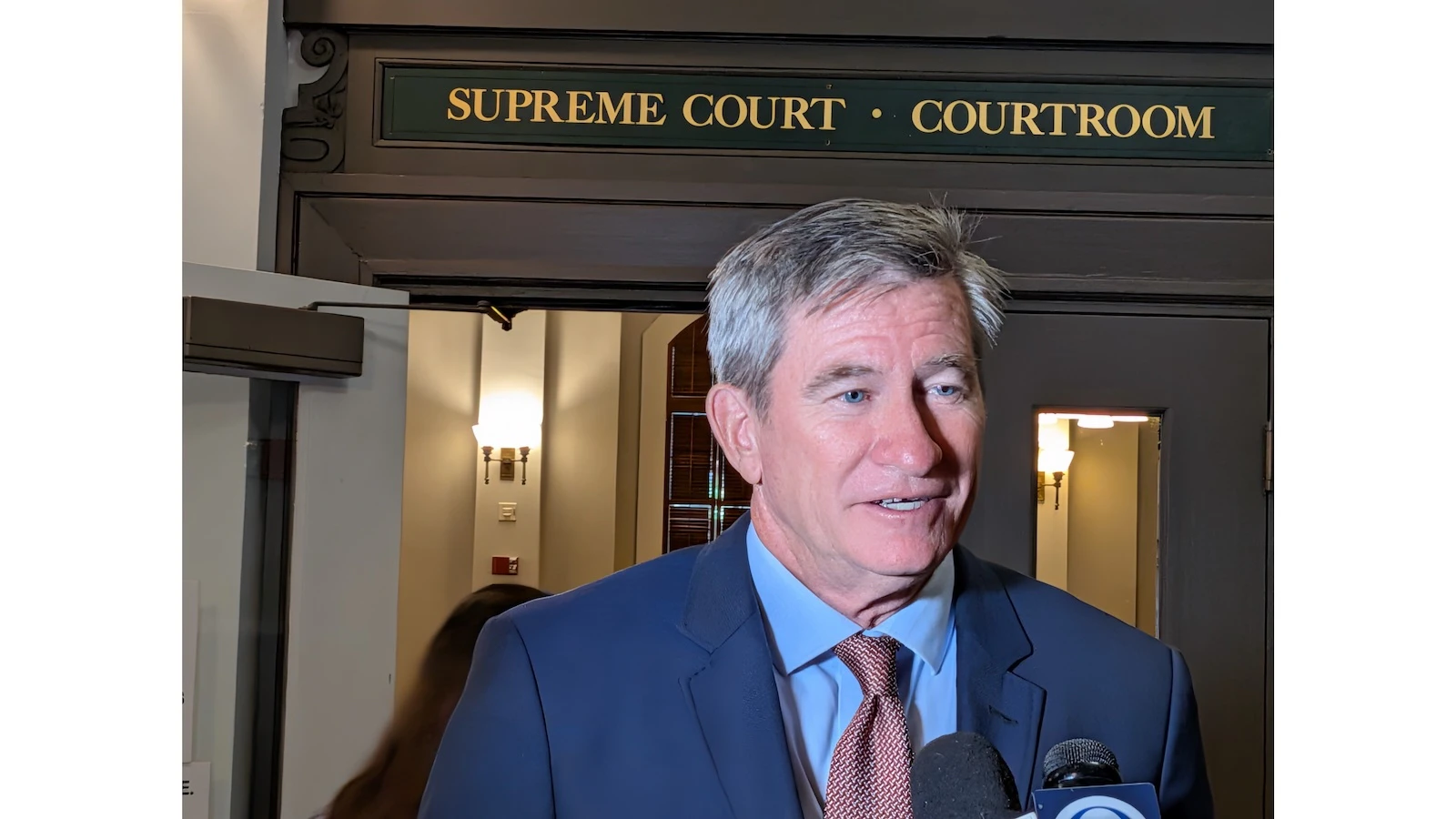
Councilman Tommy Waters will not be on the ballot in the general election this year, after the Hawai‘i Supreme Court found him ineligible to run.
Waters’ eligibility to run for reelection for the term from 2027 to 2031 has been a legal question for months, after rival candidate Trevor Ozawa filed a lawsuit against Waters in June.
The Honolulu City Charter limits council members to only two consecutive four-year terms. Waters had argued that, despite joining the council in 2019, his first term was not a full four-year term: the results of the 2018 election were disputed, leading to a special election in 2019 that he won.
Because Waters was ultimately elected after the official start of the term, he argued that the term was not served in full, which allowed him to run again this year.
The state Supreme Court determined otherwise. Writing for the opinion of the court, Associate Justice Lisa Ginoza concluded that Waters was elected to the full 2019-2023 four-year term.
“Determining whether Waters or [then-incumbent] Ozawa was elected to that term was delayed due to the challenges to the November 2018 election,” Ginoza wrote. “But it was the same four-year term to which Waters was ultimately elected.”
Ginoza wrote that the charter’s definition of a council term makes no consideration for the amount of time a council member actually serves. Rather, a four-year term is something with a fixed, predetermined period of time, to which a council member is elected.
Ginoza also addressed a complaint filed earlier this month by 40 voters in Waters’ Council District 4, which argued that declaring Waters ineligible would disenfranchise voters who submitted ballots for Waters during the primary election. According to state voter totals, 8,678 people voted for Waters in the primary, putting him in second place behind Ozawa — who received 12,279 — but above two other candidates.
Despite the claims by the 40 voters, Ginoza argued that no voters have been disenfranchised by the court’s ruling.
“The number of votes received does not render a candidate eligible for office,” Ginoza wrote, adding that choosing to keep Waters on the ballot and “let voters decide,” would also end up ignoring votes cast for third-place candidate Tara Malia Gregory, who received 4,225 votes.
As no candidate received a majority of votes in the primary, the general election will be a contest between the two candidates who received the most votes. With Waters now out of the picture, that means Gregory will be on the ballot.
For her part, Gregory filed her own challenge against the results of the primary election this week, arguing that voters who had cast ballots for Waters could have instead voted for her had they known he was ineligible to run — a First Circuit Court judge had declared Waters ineligible on July 27, only after early and absentee voting had begun.
Ginoza’s opinion was not unanimous. Acting Chief Justice Sabrina McKenna submitted her own opinion dissenting with Ginoza’s conclusions, arguing that Waters is eligible and should be on the ballot in the general election.
McKenna wrote that she believes Waters was elected to fill a vacancy in 2019 and therefore did not serve two consecutive four-year terms, and should therefore be deemed eligible. But even if his eligibility is ambiguous, McKenna wrote, “principles underlying representative democracy” require that Waters be presumed eligible.
“Respectfully, the majority’s decision determining Water ineligible is not only erroneous as a matter of law, it violates these principles of representative democracy,” McKenna wrote.
Nonetheless, Waters’ name will not appear on the ballot in the general election. Those ballots have not yet been mailed.
Ozawa said in a statement Friday that “voters deserved a clear answer and now they have one.”
“From here, the ultimate decision is with the voters of District 4 — from Hawai‘i Kai to Kaimukī and Waikīkī — where it always should be,” read Ozawa’s statement, adding that “Tommy Waters served this community and I respect that.”
Waters issued his own statement Friday saying he was “profoundly disappointed by today’s decision,” but thanked the Supreme Court for providing certainty in the matter.
“While the outcome is difficult, our system of democracy depends on respect for the rule of law and for the judicial process that brought us here,” read Waters’ statement.
For the latest news of Hawai‘i, sign up here for our free Daily Edition newsletter.