How Hawai‘i got its gas stations

Strange but true — at one time, horse-drawn carriages delivered supplies of gasoline around O‘ahu, and fuel pumps were often located by the side of the road for motorists running on empty. As gas-powered cars became more common, a new kind of building emerged in the Islands — the gas station. Guess which famous waterman owned one in Waikīkī!

DB
DeSoto Brown

September 23, 20267 min read

1950s advertising illustration of a Union Oil 76 gas station
A 1950s advertising illustration of a Union Oil 76 gas station in a setting that somewhat resembles downtown Honolulu. Notice the uniformed attendants pumping gas and wiping windshields. (DeSoto Brown Collection)

Do you think about gas stations? Probably not much, until you notice that your vehicle’s fuel level is low, and you then stop at one near your home or your work. You vaguely assume gas stations have always been around and always will be. Of course that’s not true - at least that they’re always existed.

Petroleum is a natural substance produced by nature. It comes from ancient organic matter that’s been buried underground, under pressure, for millions of years. It can be burned, making it a fuel source, something that humanity continues to require increasing amounts of. But it wasn’t until the middle 1800s that anyone finally figured out that this could be done to any significant degree with the black stuff that seeped out of the ground in certain places. Gradually petroleum — oil — would come to replace wood, coal and other oils from natural sources as the go-to source to burn for power.

This development happened to conveniently coincide with the invention of the internal-combustion engines that were utilized for the first automobiles as they evolved in Europe and the USA, beginning in the 1880s. And it was gasoline in particular, which is just one of the liquids that can be refined from crude oil, that was the most useful.

The first two autos to be imported to the Hawaiian Islands arrived in 1899, and you would understandably assume that this meant that the suppliers of petroleum-based fuels like kerosene — the most useful at that time — would need to start supplying gasoline soon after. But you’d be wrong, because (perhaps surprisingly) those very early cars didn’t use it. How could that be? Simple - they were electric! That’s not a new technology, as you might think; it’s one of the first that was used for cars.

Christian Hedemann and his electric car
Well-to-do Honolulu businessman Christian J. Hedemann was an early automobile owner. Like the other first cars in Hawai‘i, his vehicle didn’t require gasoline because it was electric. (Hedemann Collection, Bishop Museum Archives)

Obviously, though, it was gasoline power that would soon take over. In those very early days, though, there were no gas stations nor any gas pumps to fill up the tanks of automobiles. Gas was often delivered to retailers in large cans, from which the liquid was poured into smaller containers to eventually end up in cars. This was clearly a slow, cumbersome and inefficient process.
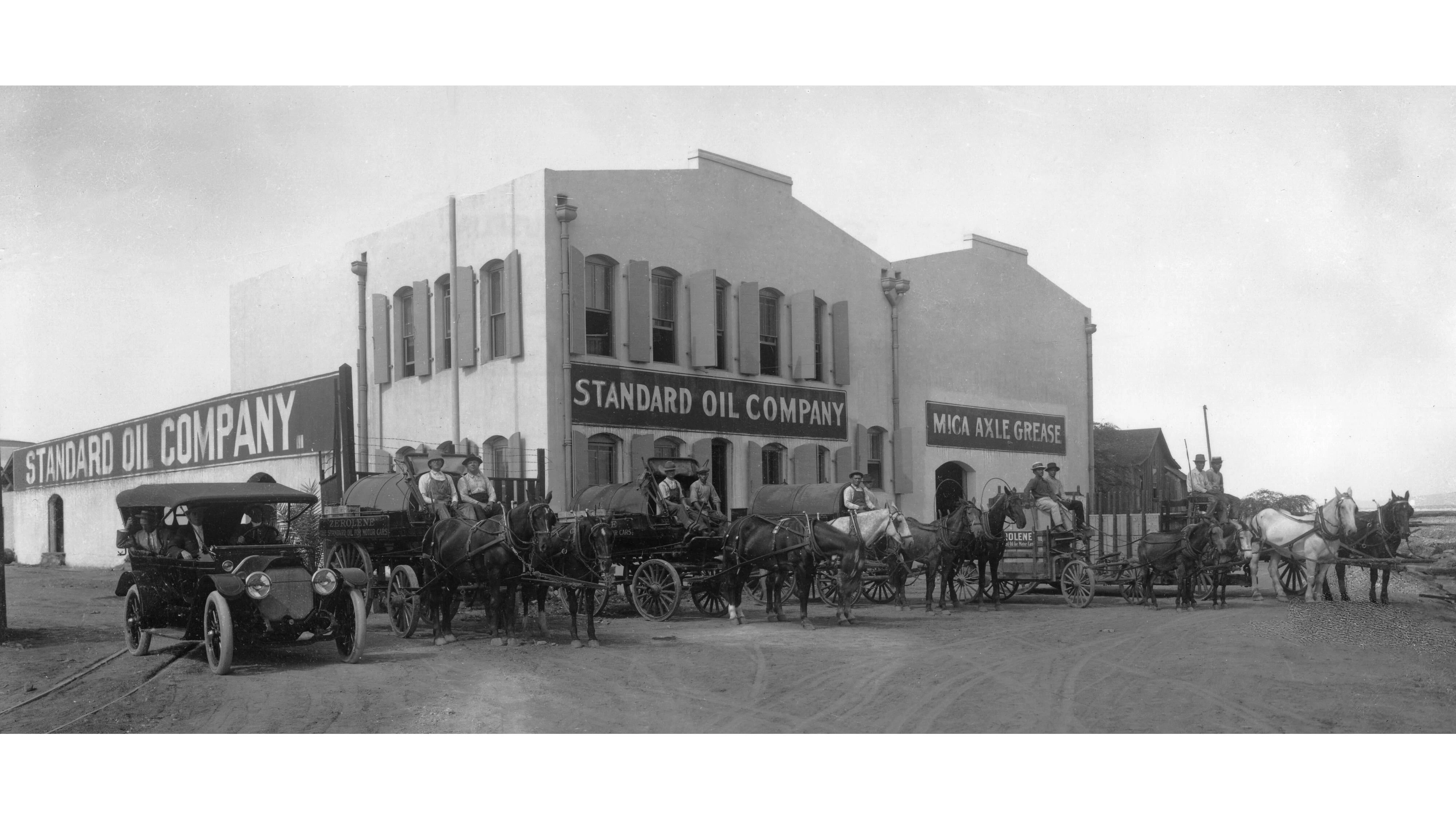
Standard Oil Co. in Honolulu 1914
Ultimate irony: Deliveries of gasoline from the Standard Oil Company facility in Honolulu in 1914 were done via horse-drawn wagons, even though there’s a single gas-powered automobile on the left in this photo. (Bishop Museum Archives)

As automobile manufacturing exploded in the United States in the early 1900s, putting it ahead of every other nation’s per capita car ownership, the delivery of gas to individual vehicles was greatly improved with the system we use today: a large tank is installed underground, and electrically-powered pumps pull it up from below ground and then into the machines that use it. With Hawai‘i’s annexation by the USA being finalized in 1900, we naturally followed what was happening throughout the entire country, including automobile ownership and all its related activities.

Gas pump on King Street 1923
Here is the mauka side of King Street near Ward Avenue in 1923. In the midst of street paving, on the right stands a curbside pump for “Filtered Gasolene” (as the lettering on the white glass globe on top reads.) Usually pumps like this one used electricity to move the fuel to the glass receptacle that’s protected here by metal mesh, from which it would then flow down just by gravity into the waiting car’s tank. (Bishop Museum Archives)
1934 gas pump in front of Waimanalo Meat Market
While curbside pumps disappeared from busy urban streets fairly early, they hung around a lot longer in rural areas, usually in front of small grocery stores. Here’s one on the right at the Waimānalo Meat Market on O‘ahu in 1934. (Bishop Museum Archives)

It might be surprising that the first gas pumps weren’t placed as they are today. Instead, they were placed on sidewalks next to streets, meaning that cars stopped to get gas might be blocking other traffic. It took awhile for the next step to occur, which was to create a dedicated space off the streets for refueling to take place.

Wailuku gas station 1930
This is the von Hamm-Young Standard Oil gas station in Wailuku, Maui in 1930. It’s of the same layout that we all know today, with a canopy roof over gas pumps that are located fully off a public street. The man in the center, to the left of the standing woman, is putting water in that car’s radiator. The hydraulic lift holding up the car at far left, which allowed mechanics to easily access the underside of a vehicle, was more usually installed inside a station and not outdoors like this one. (Bishop Museum Archives)
1938 Nuuanu gas station
At Nu‘uanu Avenue (left) and Pauoa Road (right) in 1938 we see the efficient gas station set-up of freestanding pumps which can accommodate vehicles on either side — something curbside pumps could not do. (Bishop Museum Archives)

By the 1920s in Hawai‘i, the familiar gas station was in use. This was the same as we have today: a space with a building whose roof protects one or two islands on which several gas pumps are installed. The pump hoses and handles can be used for vehicles stopped on either side, which accommodates more cars at one time, and everything is moved safely off the street and away from traffic and pedestrians.

The oil companies that owned the gas stations often wanted two things for their facilities. First, they preferred to use a standardized architectural style that made their brand’s buildings quickly recognizable to motorists, in hopes of creating customer loyalty. This was particularly because, until the 1980s, there were no credit cards that could be used universally for any kind of purchase. Drivers had to carry a different credit card for each specific gas company, making them more likely to seek out a particular brand where they could charge their purchase. And secondly, oil companies also wanted their stations to be somewhat attractive, particularly in residential areas where neighbors might be critical of an industrial-looking structure.

Duke Kahanamoku's Waikiki gas station
Duke Kahanamoku, the most famous Hawaiian in history, briefly ran two gas stations in Honolulu. Here’s his small but nice-looking Waikiki station in 1934 on Kalākaua Avenue (left) and Seaside Avenue (in the background.) Note that Duke’s name is lettered on a solid wood surfboard that’s mounted up high enough to attract attention. (DeSoto Brown Collection)
1952 gas station at Piikoi and Kona streets
Friendly Flying A Service, newly opened in 1952, stood on the corner of Pi‘ikoi Street (foreground) and Kona Street (out of view on the left). Today this site is surrounded and overshadowed by Ala Moana Center, and of course Diamond Head is no longer in view. As parts of Honolulu have been developed with highrise towers, small businesses like gas stations are pushed out. (Bishop Museum Archives)

A feature of gas stations for decades were the small colored triangular flags that fluttered from overhead ropes above the properties. In use since at least 1940 for special events, by the 1960s these flags were strung up continuously and were an easy way to spot a station as you approached.

Kokokahi Texaco in the 1960s
Kokokahi Texaco in the 1960s is decorated with colored flags. Originally these had been canvas but were replaced by plastic, seen here, which was more colorful and moved more noticeably in the breeze. (Bishop Museum Archives)
1950s Chevron ad Hawaii
A driver smiles as she watches two Chevron gas station attendants, in uniforms including peaked caps, perform the courtesy services on her 1954 Mercury convertible that were expected at that time. Windshields and other windows were wiped, oil levels were checked, and tire pressure was measured and air was added if needed. Brushing dust and debris out of the driver’s floor space was not as common, however, despite it being demonstrated in this advertising postcard. (Bishop Museum Archives)

Into the early 2000s, motorists expected a number of free services to be provided for their cars each time they got gas. First, and most importantly, only employees actually pumped gas. This was partly because the process could be a little grimy and customers did not want to dirty their hands, but also because gasoline was so flammable — and so many people still smoked at that time — that allowing unsupervised handling of the fuel was potentially dangerous. But in addition, windshields were wiped while oil levels were checked under the hood. Tire pressures were confirmed, with air being added if required. As gas prices began to rise abruptly in the 1970s, though, stations began to cut back on such amenities and to gradually shift to self service exclusively.

1979 Don Nakamoto, the owner of an ARCO station
Don Nakamoto, the owner of this ARCO station, stands ready to pump gas for a customer in 1979. Notice the abundance of engine parts visible in the background in his station’s service area on the right. (Ken Sakamoto, Bishop Museum Archives)

Possibly the biggest change in the gas station business, however, was the complete abandonment of selling car parts (including batteries and tires) along with actually repairing vehicles. This had been a long-established part of the industry and customers often dropped off their cars for such work at their favorite station. The loss of this service was partly due to the increasing complexity of car engines, but possibly more important was the decision by oil companies to simplify their work - just stick to selling gas and drop all the other stuff. Today, the older station buildings that are still in use have long since repurposed their former service bays into convenience stores, and now gas customers are entirely on their own to fill their own vehicles.

2000, mechanic at gas station
A gas station mechanic works on an engine in an oily service area in 2000. Ending such jobs meant far reduced costs for running stations, not only in payrolls but also for stocking parts and maintaining equipment. (Ken Sakamoto, Bishop Museum Archives)
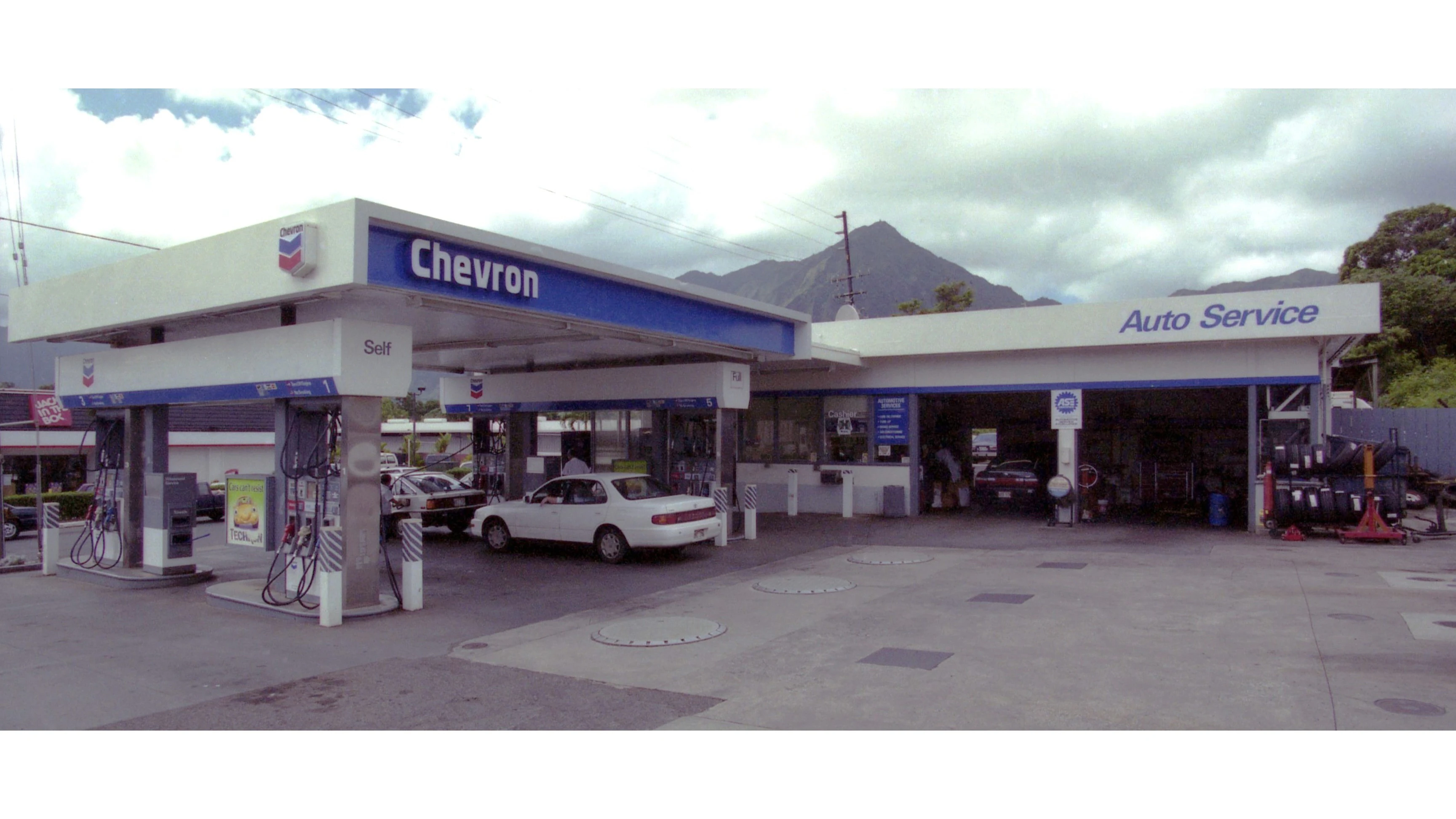
A Windward O‘ahu Chevron station, early 2000s
A Windward O‘ahu Chevron station, photographed over 25 years ago, still offered full service on the pumps nearest the building but charged lower prices on the pumps that customers used themselves, on the left. The service bays on the right are still in use for repairs. As oil companies ended the leases of full-service stations like this, these spaces were turned into the convenience stores that we expect today. (Ken Sakamoto, Bishop Museum Archives)

For the latest news of Hawai‘i, sign up here for our free Daily Edition newsletter.

Authors

DB

DeSoto Brown

DeSoto Brown is the historian and the curator for the Archives at Bishop Museum, where he's been employed for 40 years. In addition to working closely with the numerous treasures in Bishop Museum Archives, he's also accumulated a very large collection of Hawai‘i paper ephemera since the 1970s. DeSoto has authored a variety of books and articles for different publications; his titles include "Hawai‘i Recalls: Selling Romance to America," "Aloha Waikīkī," "Hawai‘i Goes To War: Life In Hawai‘i From Pearl Harbor to Peace," "Hawai‘i at Play: Images of a Bygone Era," "The Art of the Aloha Shirt," and "Surfing: Images From Bishop Museum Archives." He has also participated in exhibits for Bishop Museum and other institutions. He has been a regular commentator on ThinkTech Hawai‘i's online programs for 10 years, and even hosted his own radio show, "Melodies of Paradise", from 1975 to 1980.