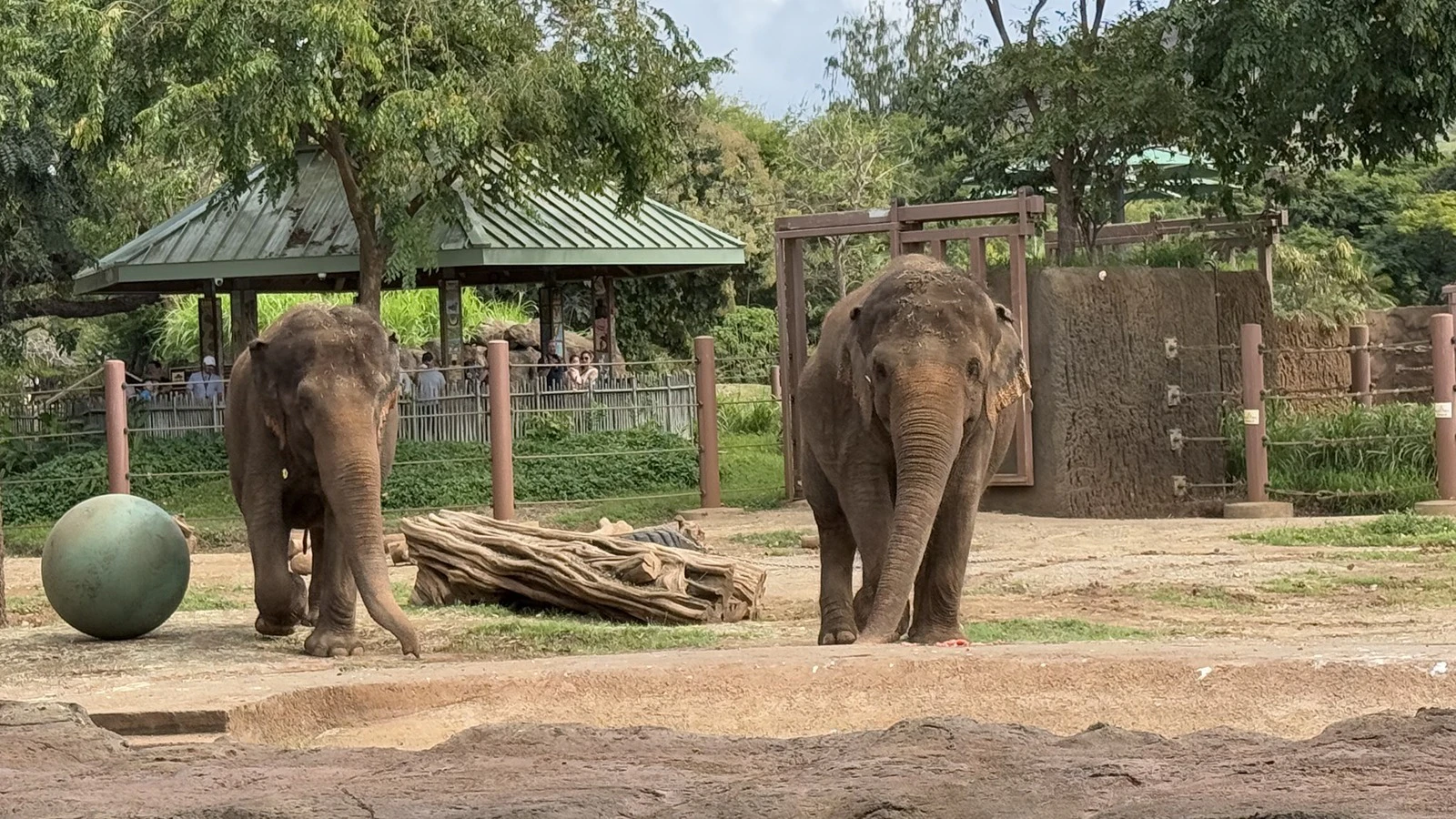
The Hawaiʻi Supreme Court will soon answer an interesting question: Under Hawaiʻi law, do two elephants at the Honolulu Zoo have a right to habeas corpus? Can these caged elephants petition to know the reason for their incarceration?
The answer, of course, is no. Elephants are not persons, and they do not have legal rights in court.
But here we are, and the court’s limited time will be spent answering this question.
The case was brought by the Nonhuman Rights Project, a nonprofit that’s filed similar cases across the country. Its founder was an animal rights lawyer inspired by the philosopher Peter Singer.
Singer is most famous for arguing that we should grant moral consideration to any sentient animal. Failure to do so is “speciesism,” according to Singer. A pig’s pain is the same as human pain. Being human, he says, counts for nothing by itself. What counts is that we are better than other animals at planning for the future (we also have thumbs).
The strategy of the Nonhuman Rights Project is to legislate through the courts. This path is much cheaper than seeking change through the legislature. Why knock on 76 doors at the Capitol when you can whisper to five robes?
Such advocates need only find a court that accepts their novel legal theory. Then they use that court’s precedent to push further in other courts. Precedent is a ratchet, and it tends to click only one way.
The courts make it easy to change law in radical ways—under cover of night. Court proceedings are hard for citizens to follow, and the jargon doesn’t help. In the audio of this hearing, the justices do not give their names, and two sit too far from the microphone to be heard.
In Hawaiʻi, there isn’t a single journalist assigned full-time to cover appellate courts. And few journalists bother to do so. So the electorate is mostly uninformed about what’s happening. Citizens can’t testify. Their only way in is an amicus brief, a legal filing few people know how to write. Judges in Hawaiʻi don’t stand for election, so they can’t be voted out.
It’s also hard to peer downstream of today’s decisions. Do two elephants at the Honolulu Zoo have a right to habeas corpus? Say yes, and tomorrow a case may ask whether the dolphins at Sea Life Park qualify. What about pet parrots? K-9s? Soon, you may have hundreds of cases seeking habeas corpus on behalf of imprisoned animals.
The courts are already overwhelmed, and this influx of afflicted animals could delay justice for human persons. And how will we sniff out the meth without our K-9 dog detectives?
It would be perfectly fine to propose a law regulating the treatment of animals. We already have such laws. We could even propose a law banning the captivity of elephants.
But nonprofits like the Nonhuman Rights Project choose to work through the courts. There they need to persuade three of five black-robed rulers that animals deserve the same legal rights as persons.
Attorney Jake Davis told the court that “person” is a legal label, not a biological one. Elephants are self-aware, empathetic, and blessed with long memories. That makes them autonomous, he said, and “autonomy is the foundation of the right to liberty.” He conceded the city-owned zoo is violating no statute or ordinance. Asked whether pigs, dolphins, or octopuses would be next, he had no answer: “I can’t recommend parameters.”
The city’s reply was simple. Slaves, women, and children won habeas cases because they were human beings, not because they passed a test for cognition.
But this case is where a secular view was always headed. Such a view has forgotten what humans are and why they have dignity.
The Western legal tradition had its categories shaped by a Christian worldview. Men and women have dignity because they are made in the image of God. “So God created man in his own image, in the image of God he created him; male and female he created them.”
There is no other account of the dignity of man that makes sense.
On a purely material view, humans are the result of time and chance acting on matter. We are cosmic stardust that slowly clumped into a planet. Then proteins bumped into each other in the primordial goo, and single cells came to life.
In this view, what makes us better than elephants?
For the secularist, there’s nothing intrinsically better about humans compared to other animals (except our thumbs). So he needs some test to decide which animals deserve special treatment.
The law needs a bright line. A creature is a person or it is not, and a judge has to be able to tell which. But the secularist can only draw his line in the sand, and the tide comes in twice a day. This year the line is self-awareness. Next year it may be memory, or the capacity to feel pain, or whatever the latest study says an octopus can do. The elephants’ lawyer could not tell the court where to draw the line.
Peter Singer says a “person” is a being with self-awareness, rationality, and preferences about its own future. In his view some animals (great apes, perhaps elephants) are persons, and some humans are not. For Singer, a severely mentally disabled human is not a person. So he allows euthanasia, abortion, and even infanticide. Infants, after all, are not rational, self-conscious beings.
When asked whether he would save a human or a mouse from a burning building, Singer says he would nearly always save the human. But it depends on the human. If the person were permanently unconscious, he writes, “it might not be better to save the human.”
If we are all protoplasm, the only way to rank protoplasm is by what it can do, and some elephants can do more than some humans. The project begins by lifting animals up to the level of persons. It ends by lowering some persons to the level of animals, and Singer is honest enough to say so. A line that can be moved to let the elephant in can be moved to leave the newborn out.
The secular view doesn’t work, but it’s just as bad to build a legal system on a creation chant. Justice Sabrina McKenna raised that possibility from the bench. Refusing the writ to animals, she said, rests on “Western cosmology” and on Genesis, in which animals are beasts to be dominated. Our constitution says to look to Hawaiian culture, she said, and under the Kumulipo, “living things are our relatives.”
Our state constitution does ask us to be mindful of our Hawaiian heritage, but that heritage is larger than one chant. The Kumulipo is old, but it did not appear in print until 1889. King Kalākaua published it to defend his family’s claim to the throne. By then Hawaiians had overthrown the kapu system by their own choice, learned to read in a single generation, and written a Declaration of Rights that opened by saying God made all nations “of one blood.” Those Hawaiians are our heritage too. They knew the old order firsthand, and they did not look back on it with the fondness of modern people who never had to live under it.
A court that goes to the Kumulipo for legal guidance will find plenty of it. The chant teaches that people are born into a caste system with high chiefs at the top. It teaches that the right to rule comes from descent from the gods. In that world, the highest chiefs were so sacred that commoners fell on their faces when one passed by.
The Kumulipo’s family tree is tangled in ways our penal code would not allow. The goddess Haumea, in Queen Liliʻuokalani’s English translation, married her children and her grandchildren, one generation after another.
Wākea, the sky father, deceives his wife and fathers Hāloa, as the old story has it, by sleeping with his own daughter. Their first child is buried, and the taro grows from the grave. In this story taro is man’s elder brother, and Hawaiians have pounded and eaten him ever since. They saw no crime in it, because kinship never made a person. If it did, every bowl of poi would be cannibalism. And the kinship between man and nature that some people find so attractive begins with a father and his daughter.
The chant also has a word for animal lovers. The dog, it says, was born as “an offering for the oven.”
If the court wants Hawaiian heritage, it should start with the Constitution of 1840. It decreed that no law shall be enacted “at variance with the word of the Lord Jehovah.” The same constitution named liberty among the rights God gave to every man, and it barred punishment without a trial.
Twelve years later the Constitution of 1852 supplied the remedy. Article 5 holds that “the privilege of the writ of habeas corpus belongs to all men.”
One of McKenna’s colleagues on the court read the line about habeas corpus aloud at the hearing. The kingdom’s word for men, the justice noted, was kānaka: human beings, as distinct from animals.
Hawaiians did not get Genesis from the Mainland last week. Their chiefs wrote it into their founding law.
Rights belong to men because God made man in His image. Elephants are owed our care, and if we want to free them, the Legislature is across the street.
Author Sterling Higa can be reached at hello@sterlinghiga.com.
For the latest news of Hawai‘i, sign up here for our free Daily Edition newsletter.