
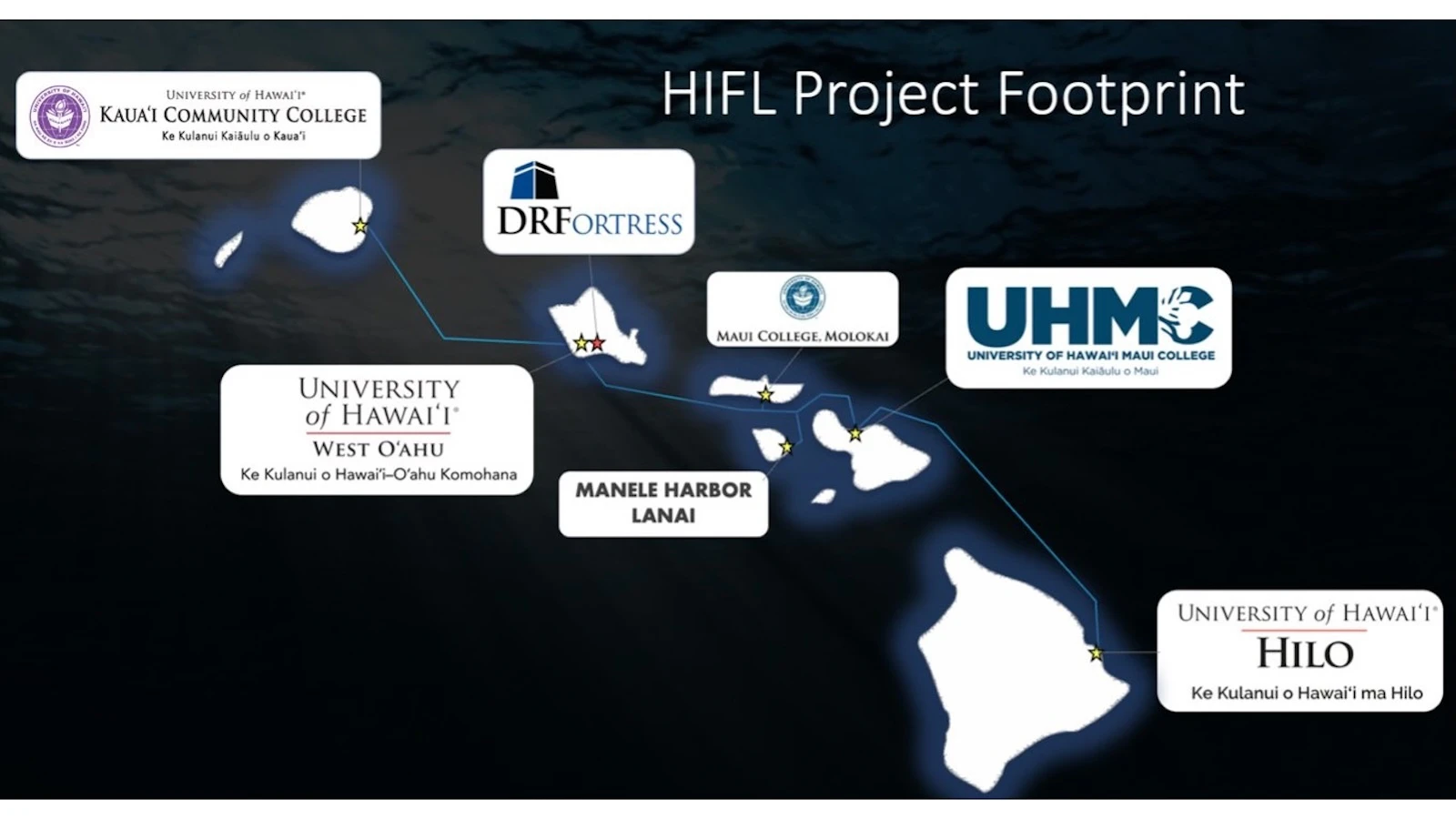
A planned $140 million statewide fiber internet system is not expected to come online until after the end of 2027.
Back in February, the Hawaiian Islands Fiber Link project was scheduled to be completed and operational by the end of this year. But after a final environmental assessment for the project was published on Monday, that completion date has been pushed back.
The state, acting through the University of Hawai‘i, has been developing the HIFL for years as a project to add much-needed redundancy to the state’s broadband infrastructure. The project is estimated to cost $140 million, about $109 million of which is coming from Covid-era federal funds for broadband development projects, with the remainder coming from private partners.
“A lot of the existing fiber networks in the state are getting old,” said Cliff Miyake, chief operating officer of Ocean Networks, Inc., the general contractor for the project. “There are three fiber networks … The oldest two I think are beyond their intended lifespan.”
The three existing fiber networks are all owned by Hawaiian Telcom, with two more than 25 years old — the generally planned lifespan of subsea fiber cables — and the third more than 15 years old.
In 2019, the entire island of Kaua‘i was left without internet and telephone service for nearly a full day thanks to a damaged cable. Miyake said the landing sites for HIFL’s cables — the points at which the subsea cable connects with cable networks on land — will be at different locations than the existing networks in order to reduce the likelihood of any single incident cutting off an entire island.
The HIFL network, when built, would consist of about 416 miles of undersea fiber cables, as well as the landing points on each island. Internet providers would supply their own connections from those landing points to end users throughout the islands.
Once completed, the network as a whole will be owned and operated by a public-private partnership between the state and ONI.
But right now, that completion date is a while away. Miyake told Aloha State Daily that the project must reach a state of “substantial completion” by the end of 2027, under the terms of the federal funds awarded to the project.
With the publication of the final environmental assessment, Miyake said ONI can now apply for all the various permits required to both lay the subsea cable and construct the landing points. He hopes that permitting process can be completed by the end of June 2027, with construction to begin in the summer of next year.
Once that begins, Miyake said a ship can lay down the entire 416-mile cable network in little more than a month.
When the network is completed, Miyake said internet users in the state may notice small improvements in connectivity.
“We should have more capacity, people might notice connectivity is a little faster,” Miyake said. He added that the increasing use of AI tools and streaming video are heavy burdens on any broadband network, which HIFL could alleviate.
For the latest news of Hawai‘i, sign up here for our free Daily Edition newsletter.


