
If you're like me, you probably think about doing two things on Independence Day.
First, you'll consider watching the film "Independence Day." If you're lazy (like me), you'll veer off to YouTube instead and find the clip where the president gives that inspiring speech. If you're still too lazy to even search for the video, here's the link.
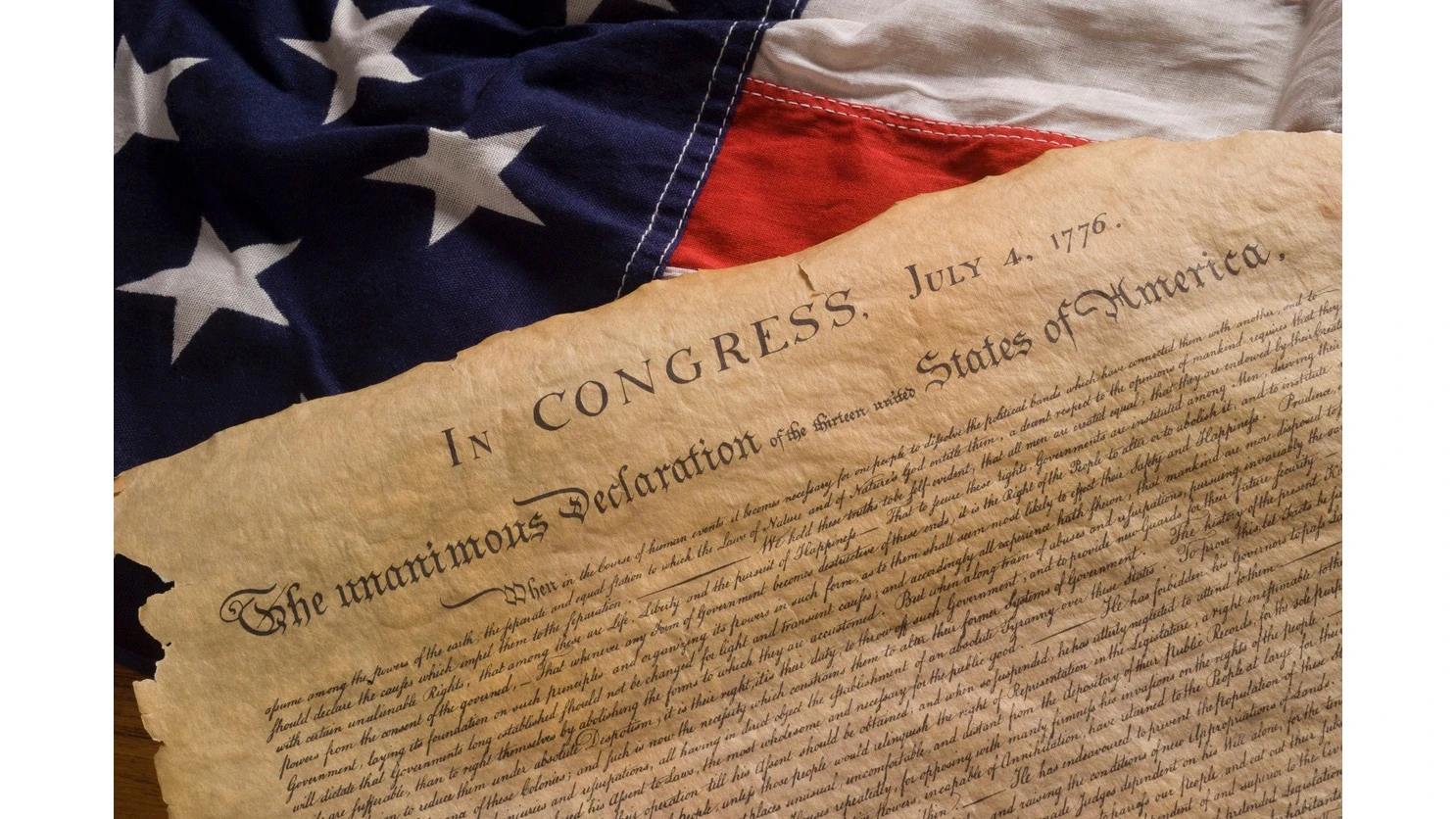
Secondly, you'll read the Declaration of Independence.
I know I'm a nerd, and I know that a lot of people don't normally read the Declaration of Independence. That's too bad, because it's shorter than you might imagine.
At only 1,320 words, it succinctly justifies a country’s existence.
In its day, the Declaration functioned as a newspaper column with serious weight. It was read in communities aloud as a physical declaration of a country’s right to exist.
It's a statement of a people's frustration with the lack of freedom and liberty. It's also an expression of their desire for a new form of government.
It’s a rejection of an unjust, unelected government and its sovereign. It’s also an acknowledgement of a community’s obligation to one another as the guarantors of their common well-being.
It begins with an explanation of how governments are formed, the dignity of people, and a government’s right to exist only with the “consent of the governed.” It proceeds to then justify the right of a people to declare their independence from Great Britain before fully resolving to secure such independence.
The document was written by imperfect people, but their idea was nearly perfect. Their words became universal. If you don't believe me, look at Vietnam's declaration of independence by Ho Chi Minh in 1945. Ho invoked the promise of the Declaration to justify Vietnam's War of Independence against the dying French Empire.
Like the Americans at Yorktown in 1781, the Vietnamese won their War of Independence at Dien Bien Phu in 1954. Tragically, Northern Vietnam's communist leanings divided the Vietnamese people, resulting in a brutal civil war that tore the country apart.
The promise of the United States is what inspired Hawai‘i’s unprecedented fight for statehood in 1959. No other territory in the American Union had ever been non-majority white. To pursue such a fight as Jim Crow persisted in the U.S. South was brave.
It was also born not out of a vision for the future tethered only to reality’s injustices, but out of what Hawai‘i’s residents demanded of this country. It was a product of the idealism first folded into the Declaration.
The Declaration’s Promise
The Declaration teaches us that being an American is difficult. Nevertheless, being an American is full of promise.
One writer, Carlos Bulosan, an Ilocano immigrant from the Philippines, painfully reckoned with this promise for the Saturday Evening Post in 1943.
Being an American is a process of becoming. It is also not set to occur in the course of one generation, or even one century. It’s a perpetual journey.
In Bulosan’s eyes, the process of realizing the Declaration’s promise was a march against circumstances. The country’s progression contained “many strands of fear and hope, that snarl and converge at several point in space and time.”
Beyond the dueling periods of fear and hope, there was still a promise, bounded by a pragmatic optimism, affixed to the country’s destiny. Such promise is what drives Americans to believe in the future. It’s not naked hope, but earnest faith in the power of a person’s agency.
“We march on, though sometimes strange moods fill our children,” he wrote. “Our march toward security and peace is the march of freedom—the freedom that we should like to become a living part of. It is the dignity of the individual to live in a society of free men, where the spirit of understanding and belief exist; of understanding that all men are equal; that all men, whatever their color, race, religion or estate, should be given equal opportunity to serve themselves and each other according to their needs and abilities.”
It’s that idea that propels the vision of the Declaration. It is an expression of a society’s faith in the power of its people. The people of the United States are the ones who declared independence. They are the ones endowed by a Creator with certain unalienable rights.
Those rights are tools. They are weapons. They are responsibilities. The right to life, liberty, and the pursuit of happiness is a noble, immortal guarantee that is only secured by a free people. It is also incumbent on every generation to truly cherish such rights. Loosing our sense of such rights is when they begin to disappear.
“The America we hope to see is not merely a physical but also a spiritual and an intellectual world,” Bulosan wrote. “We are the mirror of what America is. If America wants us to be living and free, then we must be living and free. If we fail, then America fails.”
Despite all the discrimination he faced, Bulosan never gave up on the idea of the United States. It was a country to be realized, even if it did not yet exist.
As Bulosan reminds us, it’s alright to be proud of one’s identity as an American while still reckoning with its flaws. As he painfully learned, the flaws are real and deep. That doesn't mean you give up on the promise of being an American. You embrace your country’s flaws and appreciate its nuance.
That’s the inherent promise, after all, of our political system. We strive to be more perfect, even where we fail to meet our own standards.
Like a relationship, America is full of promise. Like a relationship, America will certainly disappoint you. However, that doesn't mean you just give up on the relationship.
If you don’t believe me, take five minutes. Read the Declaration of Independence.
Perry Arrasmith can be reached at hello@perryarrasmith.com.
For the latest news of Hawai‘i, sign up here for our free Daily Edition newsletter.


