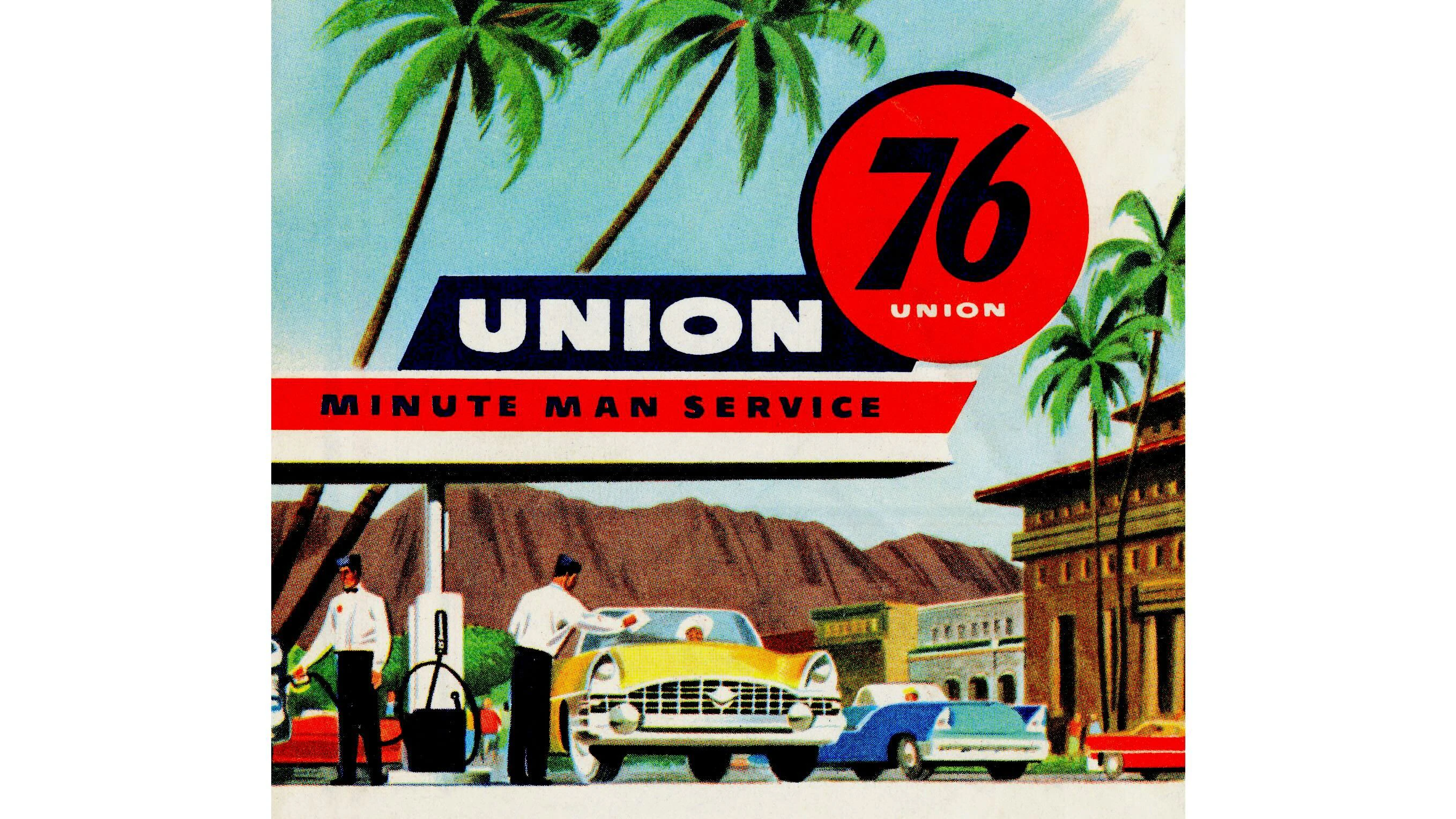
There was a time when neon signs were all over the place in Honolulu, and indeed pretty much all over the world. Today they are rare to nearly nonexistent, and they mostly evoke memories of the middle decades of the 20th century. What is neon? What made it popular, and why did it go away?
First, scientifically, neon is a rare gas which is naturally present in a small amount in earth’s atmosphere; it was first identified as an element in 1898. A French inventor, Georges Claude, discovered that if pure neon gas enclosed in an airtight glass enclosure was electrified, it would give off a bright orange-red glow. In 1912 Claude’s company, using this technology, began manufacturing the first neon advertising signs. (Although known just as “neon signs” they did, in fact, use other gases as well to produce different colors.) After coming into use in France, the first such electric signs were displayed in the USA in the early 1920s (said to specifically have been by a Los Angeles car dealership in 1923), and Americans immediately took to these amazing and striking new lights that soon would dramatically alter downtown streets by night.

Initially, the Claude Neon company registered patents in the United States for specific processes that they used in their manufacturing process. From this fact they implied that they alone were the only authorized makers of neon signs and that all competitors were potentially in legal violation of their patents. In Honolulu, as neon was first promoted to customers in 1928-1929, two competing sign companies (with confusingly similar names) that represented two manufacturers mildly battled about this in their ads. The Electric Shop, licensed by Claude Neon through a California company, stated the former “controls the neon sign patents in America” and that customers must “Beware of Imitations.” Meanwhile the Electric Supply Company, agent for QRS Neon, said it would protect customers from claims of patent infringement if any such arose.
The Electric Shop was the first to offer neon signs in Hawaii, but under cumbersome restrictions. Such signs were not sold to customers but only could be leased for three years, requiring monthly payments, with the option to extend the lease at half price after that. Meanwhile the Electric Supply Co. boasted that it sold signs outright, which probably was more attractive to buyers. The Electric Shop started things off in a big way in February 1928 by installing 33 neon signs on both Standard Oil gas stations (13 of them) and Shell stations (20 out of the 88 then on O‘ahu). The latter were said to “sparkle with beautiful Neon signs by night” in a newspaper ad on May 1, 1928. By July of the following year, some of the Honolulu businesses with neon included the Benson Smith Drug Store, Manufacturer’s Shoes, Hub Clothing, Henry May & Co. groceries, and two of the Consolidated Amusements movie theaters. By the 1930s, the latter would be adding significant amounts of neon to their theaters’ marquees and facades.


Into the 1960s, neon would be a growth industry locally. For sign companies, neon could be financially lucrative since the fragile glass tubes that created the colorful glows required constant care and maintenance. Not only could these be broken, either by mistake or intentionally by vandals, they also tended to gradually flicker or go out completely through damaged electrical connections. Signs that blinked in successive patterns would eventually go out of whack as well. And since neon was almost always mounted high up on poles or the fronts of buildings, intentionally out of reach of the public, servicing it required climbing ladders or using other mechanical means of getting to it.

All this trouble meant that customers increasingly began to choose cheaper and less problematic signs made from plastic panels illuminated from behind by fluorescent light bulbs. And as these replaced neon, the exacting technique of bending the thin glass tubes into the required shapes of letters or other designs by holding them over a very hot flame like a bunsen burner was gradually lost by the experts who once had done this work.


During the 1930s neon was mostly perceived as being a colorful and lively part of urban areas, but by the late 1940s its reputation began to slip. In detective novels and Hollywood’s famous “film noir” crime dramas, neon instead began to symbolize the sleazy parts of cities where dangerous things happened and bad guys ran wild. In Hawaii specifically, neon began to be criticized in the 1950s. Don Beachcomber, restauranteur and eventual developer of the International Market Place, advocated that all neon be banished from Waikīkī since Kalākaua Avenue was “already taking on the aspects of any mainland street at night.” A visiting ad agency executive from Minnesota warned “... for heaven’s sake, don’t make [Hawai‘i] a neon paradise and over-commercialize it." A visitor from Connecticut wrote in a newspaper letter in 1956: “Everywhere neon signs! What has happened to the people of Hawai‘i that such desecration is permitted?” But at the same time a spokesman for a group of neon dealers countered that such signs “tend to aid crime prevention” (??) and that “many tourists have inquired why Honolulu doesn’t have huge sign displays like New York’s Times Square or Florida’s Miami Beach.” (Dubious).


In the end, it wasn’t a bad reputation that brought neon’s reign to an end; it was just cost, fragility and changing technology. A revival of interest and appreciation for neon began in the 1970s but this of itself was not enough to keep its use at the level of decades past. The incredibly specialized training necessary to bend the glass tubing into complex shapes stopped and those capable of doing it died off, and eventually LEDs replaced it with equally bright colors and even more changing patterns. While neon will, it’s hoped, always survive in some fashion, never again will Hawaiian skies be as widely lit by its glow as in the 20th century.
For the latest news of Hawai‘i, sign up here for our free Daily Edition newsletter.