Changing Kaka‘ako: The ocean connection

The hundred-year-old Kewalo Basin was originally made to move fishing sampans out of busy Honolulu Harbor. At one point, 1,000 people worked in the adjacent Hawaiian Tuna Packers facility, producing up to 65,000 cans of tuna per day under the Coral brand for sale locally and on the Mainland. In time, the famous Fisherman's Wharf restaurant appeared, thrived, then shut down as well. It remains a harbor for fishing boats, but of the recreational variety, as well as for boat tours and "booze cruises."

DB
DeSoto Brown

August 21, 20267 min read

1932 Mid-Pacific Hawaiian Tuna label
A colorful 1932 paper label for Hawaiian canned tuna is a reminder of Kaka‘ako’s ocean heritage, through the Hawaiian Tuna Packers factory once located at Kewalo Basin. (DeSoto Brown Collection)

Kaka‘ako today is, for the most part, completely cut off from the ocean that is very close by. This was not always the case, however.

The ocean connection to this neighborhood for much of the 20th century was through Kewalo Basin. The construction of this small boat harbor began in 1925 as the Hawaiian Dredging Company’s equipment chewed through the shallow coral flats just offshore to dig down to a uniform depth of 25 feet while creating a channel to reach the open ocean. A concrete pier of 25 feet in width and 460 feet in length was completed in April 1926.

1940s Kewalo Basin aerial photo
This aerial view of Kewalo Basin in the late 1940s shows the Hawaiian Tuna Packers building on the left, easily identified by the lettering on its roof. Parallel to the dock is Ala Moana Boulevard with the Ward Avenue intersection on the left, and Ala Moana Park is at far right. Kaka‘ako at this time contained commercial buildings along with private homes. (Bishop Museum Archives)
1940 fishing sampans Kewalo Basin
Fishing sampans are tied up at the Kewalo dock in 1940. Beyond them can be seen the trees of Ala Moana Park along with Diamond Head in the distance, completely unobstructed by the buildings we know today. (Bishop Museum Archives)
1951 fishing sampans Kewalo Basin
By 1951, the sampans are mostly larger, with a small enclosed cabin that also functions as an elevated platform to spot schools of fish while at sea. (DeSoto Brown Collection)

The instigation for the creation of Kewalo Basin was to move the fleet of approximately 140 small fishing sampans, crewed by Japanese men, away from crowded Honolulu Harbor where they used Piers 15 and 16 near the mouth of Nu‘uanu Stream. The numerous sampans got in the way of the much larger cargo and passenger ships that had to take precedence. Although the sampans migrated at the time their new Kewalo dock was completed, conditions there were not ideal. A breakwater was needed for protection of the docked fishing boats during Kona storms, and the channel needed enlarging and deepening to prevent waves from breaking across it. These improvements would come later.

Circa 1950 women at work in Hawaiian Tuna Packers, Kewalo Basin
At Hawaiian Tuna Packers in about 1950, women handle the tuna that will be canned in various cuts. Much of the unused portions of the fish were packaged as fertilizer. Under usual weather conditions, the trade winds dispersed the unpleasant smell of the cannery over the ocean, but during Kona winds the nearby neighborhood was pervaded by the stench. (Hawaiian Historical Society)

A very important adjunct to the sampans themselves was the relocation of the Hawaiian Tuna Packers fishing processing plant to Kewalo, which happened in January 1933. The company had started in 1917 and by five years later was operating a fleet of seven sampans and was producing 10,000 to 12,000 cases of canned tuna annually. By 1933 these numbers had jumped to 65 boats and over 100,000 cases each year. The cannery employed 1,000 people at its peak operating times; 25 tons of fish were caught and 65,000 individual cans of prepared fish were produced daily. Their product was mainly sold under the Coral label, and was available all over the United States.

1950s Coral Tune advertisement
Original 1950s advertising art shows the well-known Coral tuna can that originated from Kewalo Basin to be distributed nationally. (DeSoto Brown Collection)

In time, as with many other Hawai‘i-based businesses, the tuna cannery eventually ran into difficulties. In October 1984 it closed down for what was supposed to be only a few months, but in fact it never reopened.

Kewalo Shipyard in 1955
The Kewalo Shipyard at 1052 Ala Moana, seen here in 1955, was directly mauka of the Kewalo Basin docks. It repaired existing boats as well as building new ones. Another similar business was found a few blocks in the ‘Ewa direction. (Hawai‘i Maritime Center Collection, Bishop Museum Archives)

With all this ocean-based activity happening at Kewalo, it was understandable that associated businesses would come to Kaka‘ako as well. This included fishing supply stores along with small boat builders who constructed both commercial sampans along with pleasure vessels of varying sizes.

1965 ad for restaurant Fisherman's Wharf
A 1965 ad for Fisherman’s Wharf restaurant at Kewalo Basin emphasizes the seafood specialties on offer. (DeSoto Brown Collection)

Playing off the fishing activities that were going on at Kewalo, the Spencecliff restaurant chain in April 1952 bought the existing Felix Florentine Gardens and renamed it Fisherman’s Wharf. A second floor was added a few years later and for decades, till the entire company gradually shut down, diners could look out the windows to see real-life sampans unloading their catches that were usually bound for the nearby cannery.
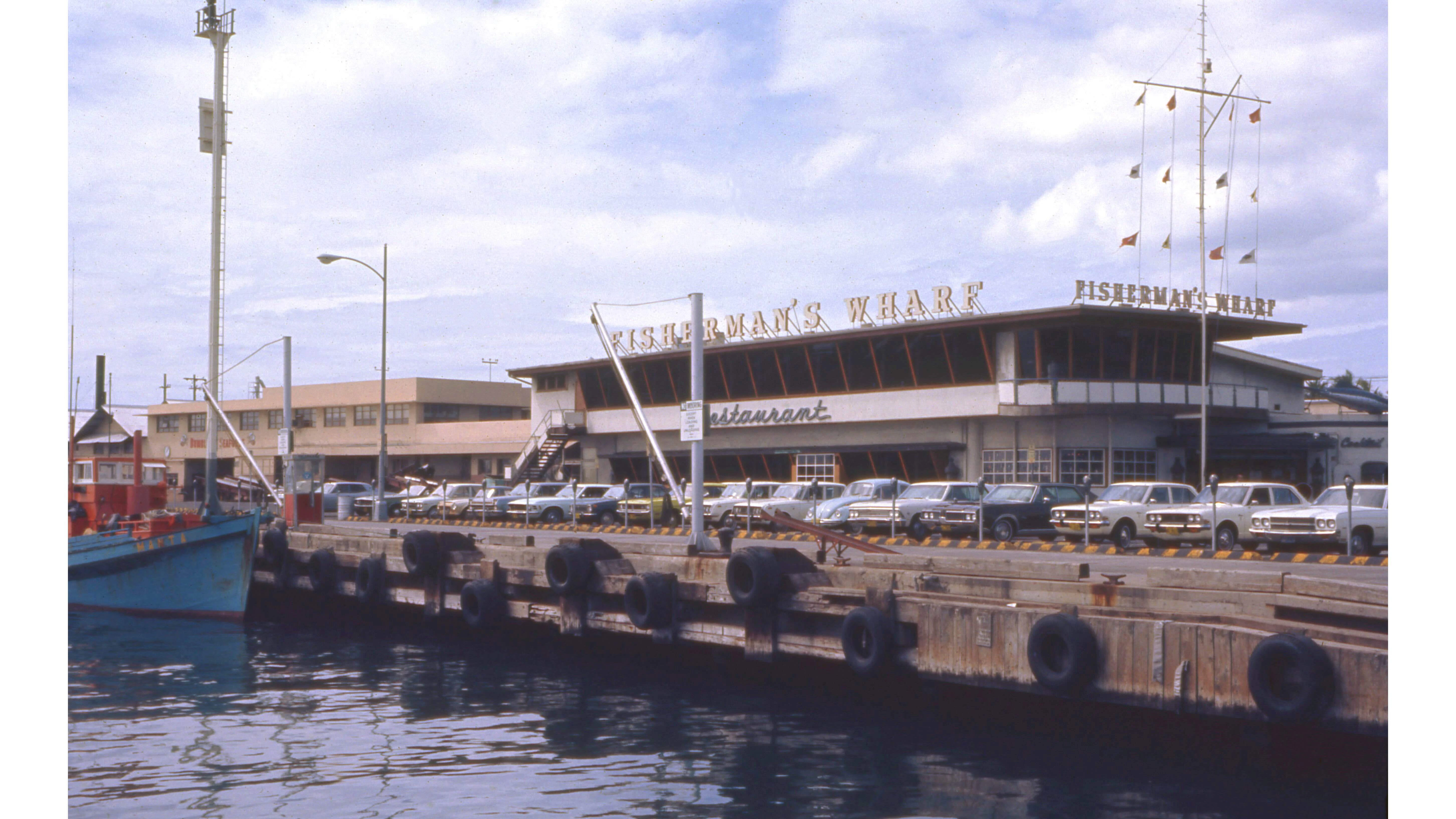
Fisherman's Wharf restaurant, 1970
This 1970 view of Fisherman’s Wharf emphasizes how close it was to the docks. To the left is a fishing sampan and to the right of it, the tuna cannery that by this time was operated under the name of Bumble Bee Seafoods. (DeSoto Brown Collection)
Tattered sign for Fisherman's Wharf after restaurant itself was long gone
For years after Fisherman’s Wharf had closed and been demolished, its neon sign somehow remained standing at the empty space it had once occupied. It’s gone today. (DeSoto Brown)

Kewalo Basin still functions as a harbor for small vessels, but these are no longer the active fishing boats of the past. Today this is the site for tourist-related activities – group tours to Pearl Harbor, nighttime “booze cruises”, or charter fishing runs. And the onshore businesses that once supported the fishing industry are gone from Kaka‘ako, along with the connection it once had to the sea.

The Diamond Head, shown in July 1958, left Kewalo for two cruises per day.
The Diamond Head, shown in July 1958, left Kewalo for two cruises per day. (DeSoto Brown Collection)
Na Hoku II tour boat Kewalo Basin 2023
Although built to resemble a double-hulled traditional Hawaiian sailing canoe, the Na Hoku II was powered by two large outboard motors to take tourists on offshore adventures. It was docked at Kewalo Basin in 2023. (DeSoto Brown)
Paradise Water Sports dockside kiosk, Kewalo Basin, present day
This Paradise Water Sports dockside kiosk was one of a number lined up at Kewalo, competing for the visitor customers who now drive the businesses in this location. (DeSoto Brown)

For the latest news of Hawai‘i, sign up here for our free Daily Edition newsletter.
Authors

DB

DeSoto Brown

DeSoto Brown is the historian and the curator for the Archives at Bishop Museum, where he's been employed for 40 years. In addition to working closely with the numerous treasures in Bishop Museum Archives, he's also accumulated a very large collection of Hawai‘i paper ephemera since the 1970s. DeSoto has authored a variety of books and articles for different publications; his titles include "Hawai‘i Recalls: Selling Romance to America," "Aloha Waikīkī," "Hawai‘i Goes To War: Life In Hawai‘i From Pearl Harbor to Peace," "Hawai‘i at Play: Images of a Bygone Era," "The Art of the Aloha Shirt," and "Surfing: Images From Bishop Museum Archives." He has also participated in exhibits for Bishop Museum and other institutions. He has been a regular commentator on ThinkTech Hawai‘i's online programs for 10 years, and even hosted his own radio show, "Melodies of Paradise", from 1975 to 1980.