
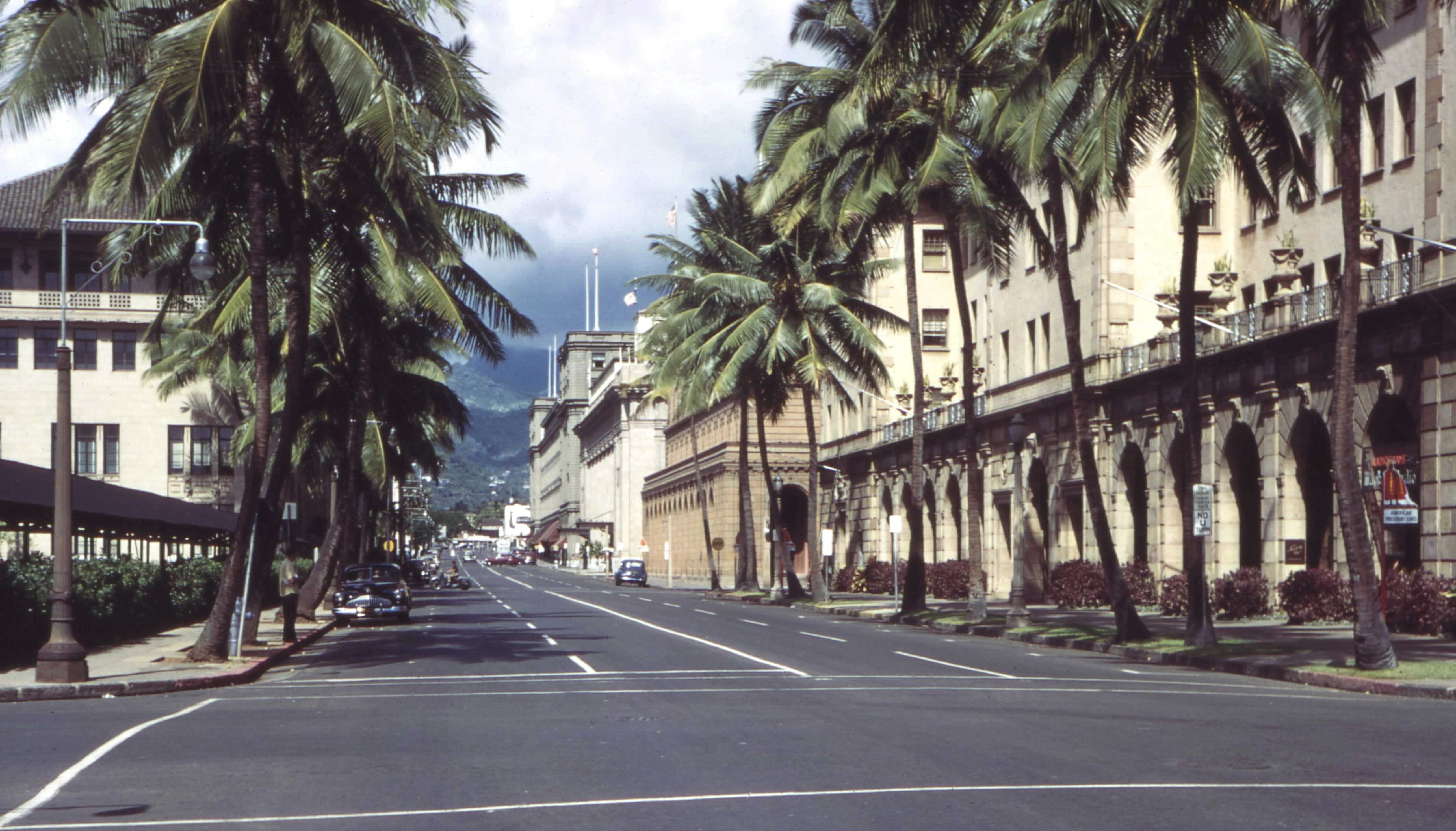
Honolulu's Bishop Street in 1949 (DeSoto Brown Collection) 
Bishop Street in 2025 (DeSoto Brown Collection)
Here’s Bishop Street, once the home of every major Hawaiian corporation in Downtown Honolulu, in a pair of then and now views from 1949 and today.
It should be a surprise to no one that many of the structures today in this location are considerably taller than the ones seen in the older photo. You can easily see that the Diamond Head side of Bishop Street in 1949, moving mauka from the second building back, formerly held the T. H. Davies building, the Bank of Bishop & Co. (today’s First Hawaiian) and the Alexander Young Hotel. None are standing today, having been replaced by high-rises.
But more interesting than these obvious newer buildings are some things that most people will not notice at all, but which are much more noteworthy. Can you guess what they could be?
If not, here’s the answer — the coconut palms. Specifically it’s the ones on both sides of the street closest to this viewpoint from Nimitz Highway. The oldest of these trees date from when the two remaining business headquarters still standing today were constructed on these two lowest blocks of Bishop Street: Alexander & Baldwin (visible on the left in the second block in 1949) and the Dillingham Transportation Building (on the right).
These coconuts were planted here by a young landscape architect who was making a name for himself nearly 100 years ago in Honolulu, Richard Tongg. A local boy of Chinese ancestry, Tongg had graduated from the University of Hawai‘i in 1923, spent about five years studying and working in California, then returned home to begin his career in 1929. He seems to have started off very successfully, quickly finding private clients with large homes as well as working on UH Mānoa’s campus and the grounds of the new Honolulu Hale.
Tongg was a fan of coconut palms and their gracefully curving trunks, and he attracted much attention by installing 10 fully grown ones in front of the new and as yet unopened Alexander & Baldwin building on Sunday, August 25, 1929. Passers-by marveled at the sudden appearance of these mature trees (where there’d been no vegetation at all) when the work week began as usual the next day. This was the first time that mature palms had been transplanted this way in Hawai‘i. Tongg must have known — along with the specialist who did the moving and planting, Henry Danner — that unlike woody trees that form major tap roots that can make transplanting difficult or impossible, palms only grow a large ball of countless small roots that can easily be dug up and will successfully regrow from being significantly pruned back.
The success of A&B’s landscaping in such a prominent location led to coconuts similarly being planted by Tongg in the next block makai, along the edge of a parking lot for the American Factors (Amfac) building, in July 1930.
The last of Bishop Street’s distinguished corporate structures, the Dillingham Transportation Building, was also graced by mature palms by Richard Tongg in time for its opening in September 1930. Tongg’s three landscaping jobs in these blocks, all of which incorporated coconut trees, gave Bishop Street a notably tropical ambience that many onlookers appreciated for obviously placing this impressive American-style business vista in its unique Hawaiian setting.
Now that you know the history of the palms that you can see in the current-day picture of Bishop Street, give them some good thoughts for their venerable ages. By now, the most aged trees here are over a century old (amazingly), since they were already 5 to 10 years of age when they were planted here nearly 100 years ago. Their great heights are evidence of their impressive lifespans. Let’s acknowledge the existences they’ve had in the heart of downtown Honolulu in spite of the unwarranted indifference most of us show them.
For the latest news of Hawai‘i, sign up here for our free Daily Edition newsletter.


