For the past three years, in addition to hula, the students of Nā Puakea o Koʻolaupoko have learned art; engineering; construction; and the value of commitment, collaboration and hard work. In 2023, the first time the Kailua-based hālau entered a float in the Aloha Festivals Floral Parade, they placed second in that division. Last year, they won the top award, and they’re looking forward to doing it again next month, which marks Aloha Festivals’ 80th anniversary.
The Aloha Festivals Floral Parade is set for Saturday, Sept. 26, from 9 a.m. to noon. Thousands of spectators will line the route from Ala Moana Park to Kapi‘olani Park to see close to 100 participating units, including floats, marching bands, pāʻū riders and more.

Keiki dancers brightened last year’s float along with an abundance of fresh flowers and greenery. (Courtesy of Nā Puakea o Koʻolaupoko) 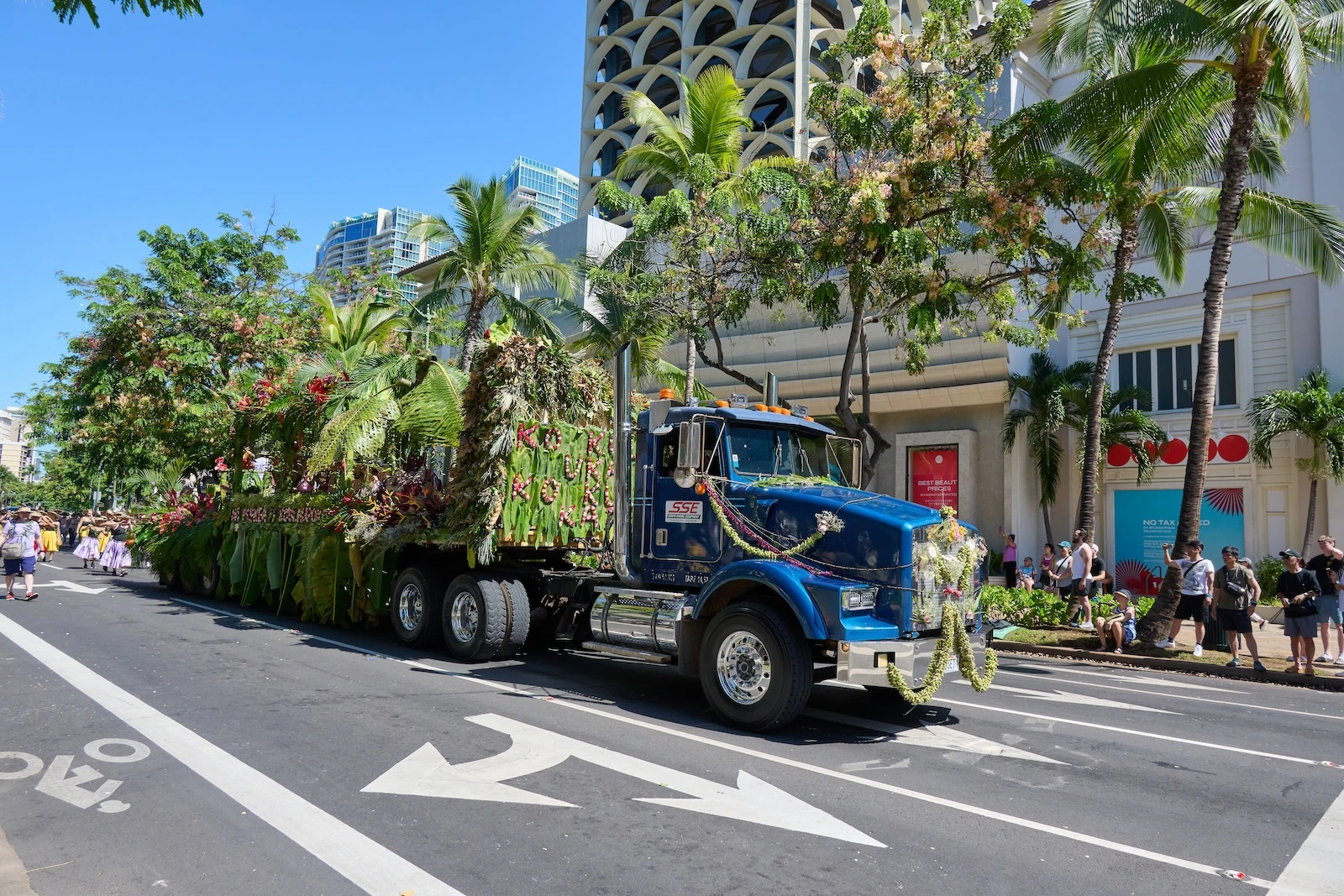
Nā Puakea o Koʻolaupoko’s float cruises down Kalākaua Avenue last year. It won first place in the parade’s float division. (Courtesy of Nā Puakea o Koʻolaupoko) 
Kumu Pattye Wright teaches a keiki class in the hula studio at her Kailua home. (Ka‘imi Koehler)
Kumu Hula Pattye Wright is the inspiring founder of Nā Puakea o Koʻolaupoko. At 91, she keeps a busy schedule that includes teaching seven weekly classes, one via Zoom for students around the world, including France, Germany, Japan, Australia and across the U.S. Mainland.
To keep fit, she attends a chair weight-lifting class at the Windward YMCA twice a week. As Kawaiaha‘o Church’s Sunday service, she’s responsible for projecting announcements, Bible verses and hymn lyrics on a large screen. And she “drives everywhere” for meetings and outings, often with friends who are decades younger as passengers.

In October, Wright will be in Japan for two-plus weeks, conducting hula workshops from the northernmost island of Hokkaido all the way south to Okinawa. “I’m proof that you can enjoy a full life in your 90s,” she said. “One reason that has been possible for me is that I live in gratitude. Negativity and gratitude cannot survive in the same space.”
Wright was born in rural Fleming, Missouri, and raised all over the country as the daughter of an Air Force chaplain. She bought her first ukulele when her family was living in Pittsburg, Kansas, in the 1940s.
“My friend Rita lived down the street from me, and she had an ukulele,” Wright said. “I wanted one, too, so I started saving my allowance, which I think was 25 cents a week. My grandmother gave me $5 for my 12th birthday, which was enough for me to get the ukulele I liked at a store in Pittsburg.”
She and Rita caught the bus into town, where she bought the ukulele and a little Hawaiian songbook. On the way home, the girls sat in the back of the bus and sang their hearts out.
“I cringe to think how we probably mangled the words to ‘My Little Grass Shack,’” Wright said. “That ukulele went with me everywhere; I still have it. I also play the piano and organ, and I’ve always sung in church choirs. Every place I’ve lived, I’ve immersed myself in the local culture, beginning with music.”
It was no different in 1968, when Wright’s then-husband, an electrical engineer, accepted a job on O‘ahu. She initially thought it was going to be a three-year stint, but she wound up never leaving Hawai‘i.
“We arrived in November, and I was in my first hula class by January,” Wright said. “We hadn’t even fully unpacked, but I couldn’t wait to start. History, storytelling, poetry, music, dance — hula has it all, and I loved it!”
Wright learned how to craft her own implements; took Hawaiian language classes at the University of Hawai‘i at Mānoa; and studied with renowned Kumu Hula Bella Richards and Lani Kalama. When she started Nā Puakea o Koʻolaupoko in 1973, she realized hula could play an important role in educating people about the Hawaiian culture.
In August 2023, Toni Lee, then-chair of the Aloha Festivals parade, approached Shiori Kaʻimilani Koehler, another kumu for the hālau, with an invitation: Would they be interested in entering a float? Intrigued, Koehler presented the idea to Wright, who gave it the green light.
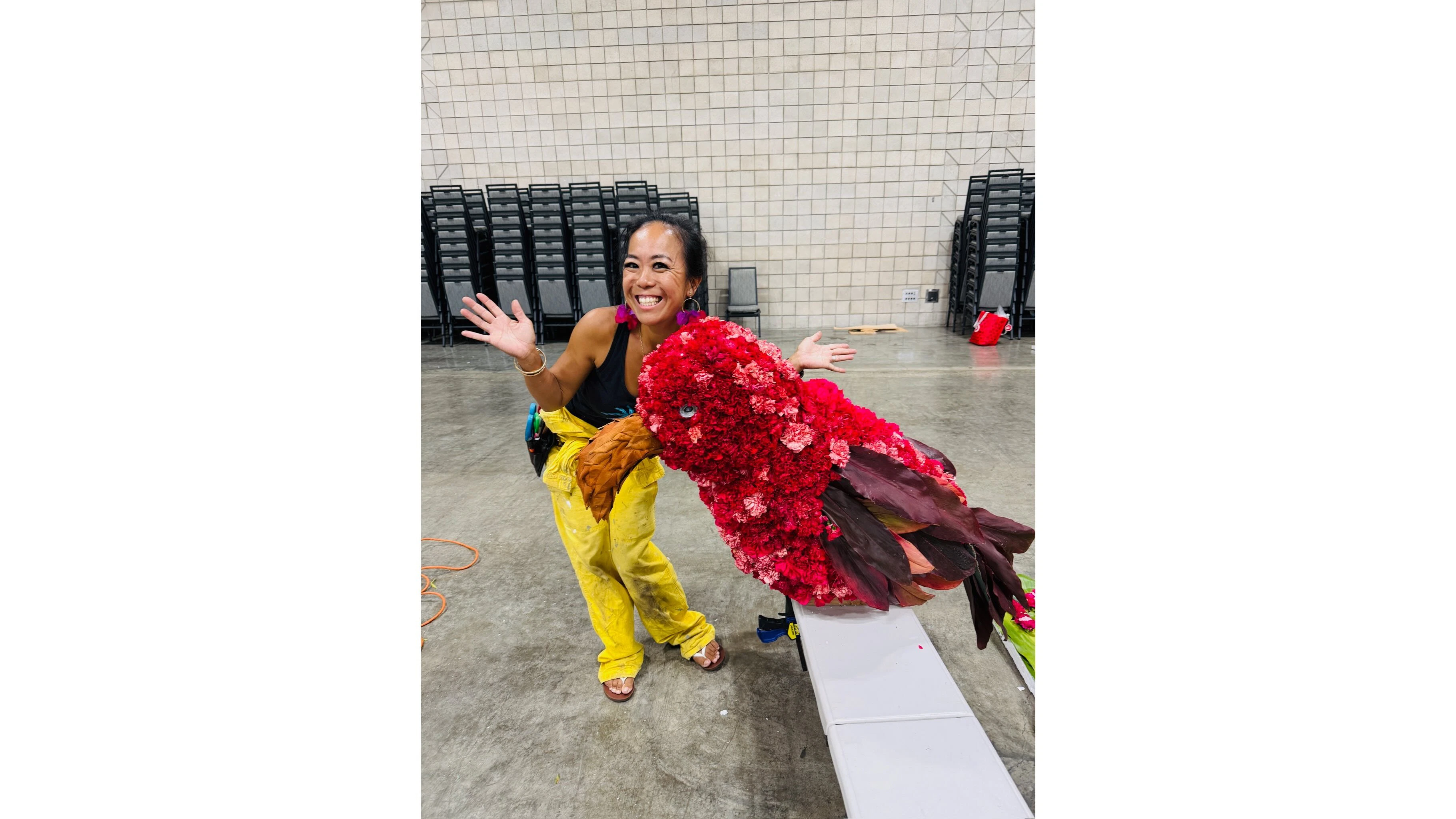
A glass artist and glass art instructor at UH-Mānoa, Koehler oversees the project and is hands-on with every aspect of it, including conceiving the design, building the float and, in consultation with Wright, selecting the numbers the hālau performs during the parade.
Wright helps however she can — making lei to decorate the float with students, teaching them the songs and dances, and creating the beautiful floral adornments she wears on parade day.
“Participating in the parade is an opportunity for our hālau to share hula, aloha and our culture with spectators,” Koehler said. “It’s also educational for our students; for example, they have learned how to make lei and weave coconut frond hats together. The parade has become a meaningful tradition, allowing us to honor our heritage while strengthening our bonds.”
Aloha Festivals’ theme this year is “80 Years of Aloha: Our Culture, Our Stories, Celebrating Our Island Home.” Koehler wants to keep this year’s float design a surprise, but she confirmed preparations are well underway.
“We’re starting to build the framework,” she said. “One of the parade requirements is that all decorations must be made from natural vegetation. Our hālau and our friends, relatives and neighbors will gather ti leaves, palm leaves and more from their yards. We’ll purchase fresh flowers, floral foam, lumber, hardware and other supplies.”
Murakami Landscaping donates greenery, and South Shore Equipment provides use of a flatbed truck. Other than that, expenses are paid out of pocket. Each student contributes $30 to the float fund. Fundraisers supplement that, including lauhala weaving classes and sales of baked goods and hālau T-shirts worn by students and supporters, around 70 strong, who follow the float.
Construction (place to be determined) will begin on the Tuesday prior to the parade and go on through late Friday evening when everything must be done. It adds up to months of planning and labor for just three hours in the spotlight. Still, Koehler believes, it is worth it.
“Hula teaches us the importance of humility, respect, integrity, discipline and aloha,” she said. “Building the float requires those same values. It’s a collaborative effort that depends on laulima, many hands working together. The parade is more than a performance; it is a celebration of our hālau, our culture and the relationships that unite us as one ʻohana.”
For the latest news of Hawai‘i, sign up here for our free Daily Edition newsletter.